How to Read Changing Lines in Liuyao: Change Is Evidence, Not Intimidation
Liuyao · July 15, 2026
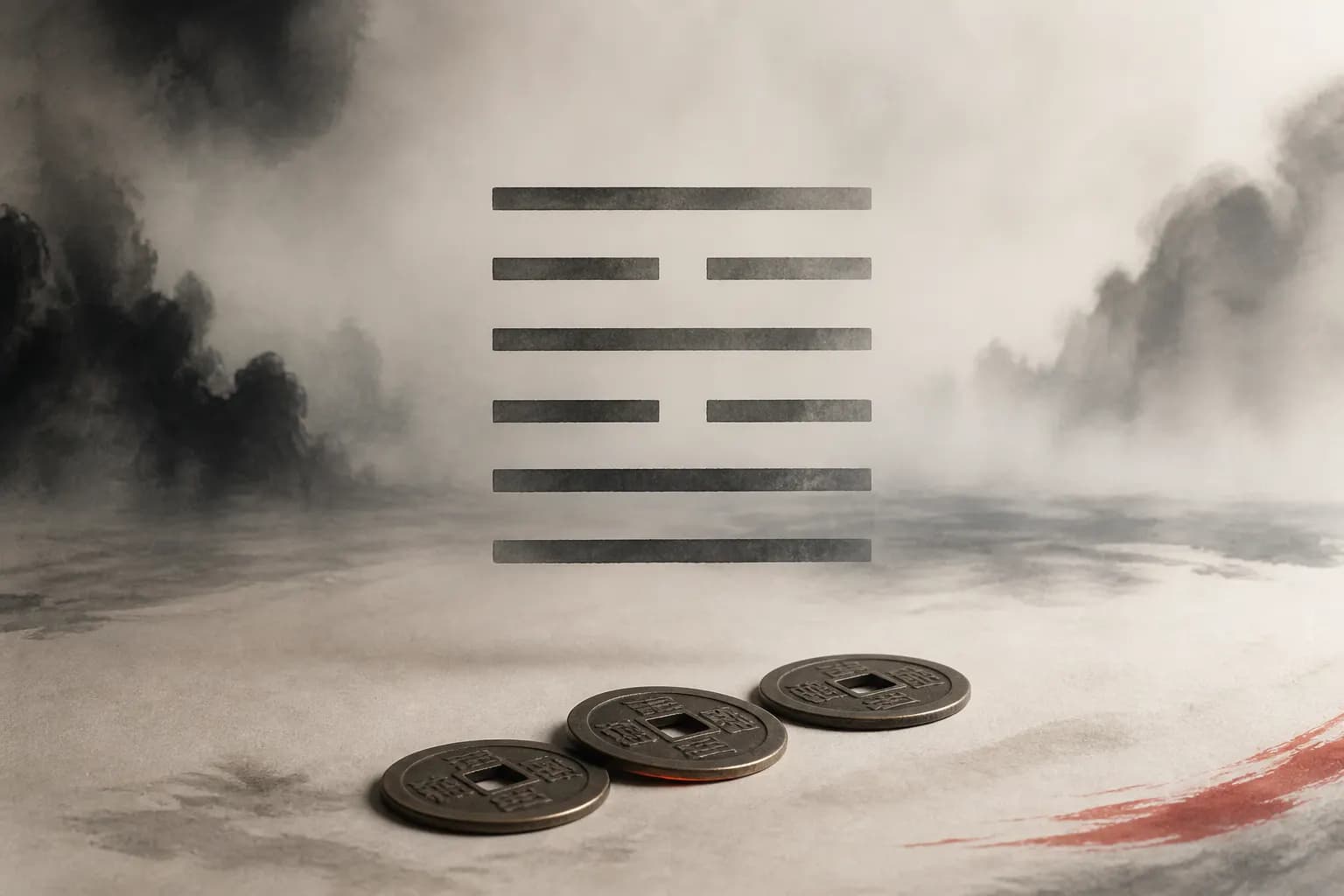
You've tossed the coins six times, assembled the hexagram, mapped the Six Relatives, and located the Useful Line — and then you notice: there are changing lines.
A lot of people's first reaction is anxiety. "Does a changing line mean something bad?" "Does it mean things are going to shift?" "Does it mean something's gone wrong?"
No. A changing line is simply a line in the hexagram that is in the process of transforming. It doesn't forecast good or bad fortune — it tells you **where things are changing**. Whether the change is favorable or unfavorable depends on the direction of the change, not the act of changing itself.
This article covers three things clearly: what changing lines are, what they transform into, and what those transformations mean for reading a hexagram.
The Nature of Changing Lines: Yin and Yang at Their Extremes
When casting a hexagram with three coins, each toss yields one of four results:
| Coin Result | Name | Meaning |
|---|---|---|
| Three tails | Old Yin ⚋× | Yin at its extreme, about to become Yang → **Changing line** |
| Three heads | Old Yang ⚊○ | Yang at its extreme, about to become Yin → **Changing line** |
| Two tails, one head | Young Yang ⚊ | Yang, stable → Static line |
| Two heads, one tail | Young Yin ⚋ | Yin, stable → Static line |
Old Yin and Old Yang are called "old" because they've reached their extreme. When something reaches its extreme, it must reverse — that's a fundamental principle. So they're called changing lines: not because something has "gone wrong," but because they've reached a turning point.
A changing line transforms from yin to yang or yang to yin. The line it transforms into is called the **changed line**. The original hexagram plus the changed lines form a new hexagram called the **changed hexagram** (also called the "target hexagram").
The logical chain looks like this:
1. You cast Old Yang or Old Yin → a line is changing 2. The changing line flips to the opposite polarity → producing a changed line 3. The changed line has its own earthly branch, five-element attribute, and Six Relative → introducing new information 4. This new information is layered on top of the original hexagram → forming a complete basis for judgment
So a changing line isn't a traffic light — traffic lights are simple. A changing line is more like supplementary evidence. The original hexagram is the case summary; the changing lines are newly submitted evidence. The evidence itself doesn't make the ruling for you, but it changes how you understand the case.
Hexagrams Without Changing Lines: Static Hexagrams
When all six lines are Young Yin or Young Yang and nothing has changed, it's called a **static hexagram**.
A static hexagram doesn't mean "no information." Its information pattern is simply different: the prosperity or weakness of the Useful Line, the influence of the Month and Day branches, the structural composition of the hexagram itself — these are already enough to make a judgment. A static hexagram says that **the current situation is relatively stable**, with no obvious turning force driving change in the short term.
The ancients said "no movement, no divination; no movement, no judgment" — this has truth to it, but don't overinterpret it. What it means is: without changing lines, your reading focuses on "state," not "change." Is the Useful Line prosperous? Is it being restricted by the Month branch? Is the Subject-Object relationship favorable? These are the priorities for static hexagrams.
The difference between having changing lines and not having them lies in the **analytical dimension**, not in good or bad.
How Many Changing Lines: From Single Activation to Full Change
The number of changing lines directly determines the complexity of your analysis.
Single Activation: Just One Changing Line
Single activation is the clearest case. The ancients said "the single activator is supreme" — the one line that moved is the key to the matter.
Reading a single activation is straightforward. The core question is: **what is the relationship between this changing line and the Useful Line?**
- Changing line generates the Useful Line → There's support - Changing line restricts the Useful Line → There's resistance - The changing line IS the Useful Line → The Useful Line has activated on its own; the initiative is in your hands - Changing line generates the Subject line → External conditions favor you - Changing line restricts the Subject line → External conditions work against you
At the same time, consider the changing line's own state: a prosperous changing line carries more force, a weak one carries less. You also need to look at what it transforms into — more on that below.
Multiple Activation: Two or More Changing Lines
When two or more lines are changing, the situation gets complex. Multiple changing lines generate and restrict each other, pulling in different directions. You need to sort out who's the main actor and who's the supporting cast.
The reading order for multiple-activation hexagrams:
1. **Find the Useful Line first** — it is always the most important. 2. See which changing line has the most direct relationship with the Useful Line — that's your main actor. 3. Assess the prosperity or weakness of each changing line — prosperous ones carry more weight. 4. Trace the generation-restriction chains among changing lines — A restricts B, B generates C; clarify the causality.
One more note: the case where all six lines change is extremely rare. If it does occur, the standard approach follows Zhu Xi's *Introduction to the Study of the Yijing* (handling yin and yang lines separately), but that's beyond the scope of this article.
What Changing Lines Transform Into: Four Basic Types of Transformation
After a changing line transforms into a changed line, the changed line exerts influence back on the changing line in different directions. This is the core of changing-line analysis.
Advancing Spirit: Growing Stronger
When the changed line shares the **same five element** as the changing line, and the changed line's earthly branch is "one step forward" from the changing line's branch, it's called **transforming to the Advancing Spirit** (化进神).
The standard four pairs:
| Changing Line → Changed Line | Element | Advance/Retreat |
|---|---|---|
| Hài → Zǐ | Water | Advance |
| Yín → Mǎo | Wood | Advance |
| Sì → Wǔ | Fire | Advance |
| Shēn → Yǒu | Metal | Advance |
The meaning of advancing: **strength is increasing, the trend is moving forward.**
- Useful Line transforms to advancing → The situation grows increasingly favorable - Resource Line transforms to advancing → Support keeps getting stronger - Tabu Line transforms to advancing → Resistance keeps growing (be cautious)
But there's a critical detail: **whether the transformation is real depends on whether the changing line itself is prosperous.** If the changing line is prosperous, advancing is real advancing — icing on the cake. If the changing line is weak, advancing is fake advancing — a sick person trying to run; the will is there but the strength isn't.
Retreating Spirit: Losing Strength
The reverse of advancing: the changed line shares the same five element as the changing line, but the earthly branch steps backward.
| Changing Line → Changed Line | Element | Advance/Retreat |
|---|---|---|
| Zǐ → Hài | Water | Retreat |
| Mǎo → Yín | Wood | Retreat |
| Wǔ → Sì | Fire | Retreat |
| Yǒu → Shēn | Metal | Retreat |
The meaning of retreating: **strength is decreasing, the trend is pulling back.**
- Useful Line transforms to retreating → Things don't go as expected - Resource Line transforms to retreating → Support is fading - Tabu Line transforms to retreating → Actually good news; the harmful force is weakening
The same true-fake distinction applies: a prosperous line retreating is fake retreating — a tiger losing one hair is still a tiger. A weak line retreating is real retreating — adding injury to insult.
Transforming into Void: The Change Falls Empty
When the changed line produced by a changing line happens to fall on a Void-of-Decade (旬空亡) position, it's called **transforming into void** (化空).
The meaning of void: **the result of the change cannot materialize — for now.** Note the emphasis on "for now." Void doesn't mean permanent disappearance; it means "not yet the right time." When the day comes when the voided position is filled or clashed open, the changed line's effect will resume.
There's an important principle here: **a moving line is not nullified by void.** Even if the changing line itself sits in a voided position, because it has already activated, it retains the ability to generate or restrict other lines. But when a changed line falls into void, the effects from that side are temporarily shelved.
- Useful Line transforms to void → The matter won't come through for now; wait for the void to clear - Resource Line transforms to void → Support is temporarily unavailable - Tabu Line transforms to void → Breathe easy for now, but stay alert once the void clears
Transforming into Grave: Strength Is Imprisoned
When the changed line happens to be the grave (tomb) position of the changing line's own five element, it's called **transforming into grave** (化墓).
Five-element graves:
| Element | Grave Position |
|---|---|
| Water | Chén |
| Wood | Wèi |
| Fire | Xū |
| Metal | Chǒu |
| Earth | Chén (primary) |
Transforming into grave isn't death — it's "being locked up." The strength is still there, but it can't be deployed. It's like a person locked in a storage room — they haven't ceased to exist, but they can't get out.
- Useful Line transforms to grave → The matter is obstructed, delayed - Tabu Line transforms to grave → The harmful force can't act for now — actually good news
Graves also come in true and fake forms. A prosperous line transforming into grave is a fake grave — a strong person temporarily locked up; once the grave is clashed open, they recover. A weak line transforming into grave is a real grave — already feeble, and being locked away may mean they truly can't get out.
Turning Back to Generate and Turning Back to Restrict: The Changed Line's Direct Action on the Changing Line
Beyond the "same-element" transformations like advancing, retreating, void, and grave, the most common usage of changed lines is **turning back to generate** (回头生) and **turning back to restrict** (回头克).
Turning Back to Generate
When the five element of the changed line **generates** the five element of the changing line, it's called turning back to generate.
For example: Hài Water activates and transforms into Yín Wood. Wait — Wood generates Water? No, Water generates Wood. Let me give a correct example: Shēn Metal activates and transforms into Chén Earth. Earth generates Metal — that's turning back to generate.
The meaning of turning back to generate: **after the changing line activates, it actually gets reinforced.** Activation itself is already a powerful action; when the changed line turns back to generate it, it's like adding another layer of strength.
- Useful Line activates and transforms with turning back to generate → Great fortune. The Useful Line already has initiative and is further empowered. - Resource Line activates and transforms with turning back to generate → Support exists and continues to strengthen.
Turning Back to Restrict
When the five element of the changed line **restricts** the five element of the changing line, it's called turning back to restrict.
For example: Yín Wood activates and transforms into Shēn Metal. Metal restricts Wood — that's turning back to restrict.
The meaning of turning back to restrict: **after the changing line activates, it gets weakened or even canceled out.** The line activated to drive change, but the direction of change ends up consuming itself. It's like charging out to fight, only to discover your own backyard is on fire.
- Useful Line activates and transforms with turning back to restrict → Great misfortune. The Useful Line wanted to accomplish something but gets dissolved by its own transformation. - Tabu Line activates and transforms with turning back to restrict → Actually good news. The harmful force consumes itself.
Turning back to generate and turning back to restrict are the **two most powerful signals in changing-line analysis** — more directly impactful than advancing or retreating. When reading a hexagram, always check for these first. If they exist, they take priority over ordinary generation-restriction relationships.
Hidden Movement: The Unmarked Changing Line
Beyond the Old Yin and Old Yang directly produced by the coin toss (overt movement), there's an "invisible" kind of changing line called **hidden movement** (暗动).
Conditions for hidden movement:
1. The line is a static line (no Old Yin or Old Yang marker) 2. The Day branch forms a **Six-Clash** (六冲) relationship with the line's earthly branch 3. The line is **prosperous** (supported by the Month branch or in its own season)
All three conditions must be met. When a prosperous static line is clashed by the Day branch, it secretly "activates." When a weak static line is clashed, it's not hidden movement — it's **Day-Break** (日破): its foundation is destroyed.
The *Zēngshān Bǔ Yì* puts it clearly: "For a prosperous line, the Day clash means hidden movement; for a weak line, the Day clash means Day-Break."
The effect of hidden movement falls between a static line and an overt moving line: it can generate or restrict other lines, but with less force than an overt moving line. It represents **latent change energy** — not yet surfaced, but advancing in the background.
- Useful Line with hidden movement → The matter is progressing behind the scenes; there's a turning point - Tabu Line with hidden movement → Danger is quietly building; stay alert
Hidden movement has no changed line, so it doesn't involve advancing, retreating, turning back to generate, or turning back to restrict. It simply gains one extra capability: the ability to generate or restrict other lines.
Moving But Meeting Combination: The Tied-Up Changing Line
When a changing line is **combined** with the Month branch, Day branch, or another changing line, it's called "moving but meeting combination" (动而逢合), also known as being **tied up** (绊住).
Being combined means the changing line wants to exert its influence but is temporarily held back. It's like a person about to leave the house whose feet are tangled in rope — not unable to walk, just unable to walk *yet*.
A tied-up changing line's generation and restriction capabilities are temporarily suspended. But combination is not restriction — being tied up is not the same as being killed. When the day comes that the combination is **clashed open** (for example, Zǐ-Chǒu combination meets a Wèi day), the tied-up changing line regains its freedom and fires again.
Moving but meeting combination is especially useful in timing judgment: it directly tells you that the matter won't break through until a specific time point.
A Complete Workflow
When facing a hexagram with changing lines, I recommend analyzing in this order:
**Step 1: Locate the Useful Line.** This is always the first step. Without the Useful Line, the good or bad fortune of changing lines has no reference point.
**Step 2: Check whether the Useful Line itself is changing.** If the Useful Line has activated, the matter you asked about is in active flux — favorable events pushing forward or unfavorable events deteriorating, depending on its prosperity and transformation.
**Step 3: Examine the relationship between changing lines and the Useful Line.** Are other changing lines generating or restricting the Useful Line? Has the Resource Line activated to help? Has the Tabu Line activated to cause trouble?
**Step 4: Analyze each changing line's transformation.** Advancing or retreating? Turning back to generate or turning back to restrict? Void or grave? These details determine the quality of the change.
**Step 5: Check for hidden movement and combinations.** Do any hidden-movement lines affect the situation? Is any changing line tied up? These "hidden variables" are the ones beginners overlook most often.
**Step 6: Synthesize and conclude.** Don't evaluate any single factor in isolation. Changing lines are clues and evidence, but the final judgment depends on the complete picture assembled from all the clues together.
The Most Common Misconceptions
At the end, I'll repeat what I said at the beginning: **changing lines are evidence, not intimidation.**
Specifically, the mistakes beginners make most often:
**"Changing means something bad"** — There's absolutely no truth to this. When the Useful Line transforms with turning back to generate, or the Resource Line is the sole activator generating the Useful Line, these changing lines are good news. Changing lines simply tell you that things are shifting; whether the shift is good or bad depends on the direction of the change.
**"Changing lines are more important than static lines, so only look at changing lines"** — Wrong. If the Useful Line is a static line but prosperous and aligned with the Month branch, its condition may be more critical than a weak changing line. Moving versus static is one analytical dimension among many, not the only one.
**"Advancing is always good, retreating is always bad"** — Reading without distinguishing true from fake advancing/retreating is reckless judgment. A weak line transforming to advance is fake advancing; a prosperous line transforming to retreat is fake retreating. You can't just read the label.
**"The changed line is more important than the changing line"** — Wrong. The changing line is the cause; the changed line is the effect. No cause, no effect. If the changing line itself is scattered by the Day clash, the changed line can be perfect and still amount to nothing.
A changing line is not a danger signal in the hexagram. It's an open window — letting you see where things are changing, in what direction, and with how much force. The rest you handle with the prosperity judgments and Six Relative relationships you've already learned.
Every coin toss in Liuyao is an act of information gathering. The changing line is the most active variable in this information system. Respect it, analyze it — but don't be afraid of it.