
When Does Da Yun Start?
Use solar terms, forward or reverse sequence, and conversion rules before interpreting the phase.
Overview
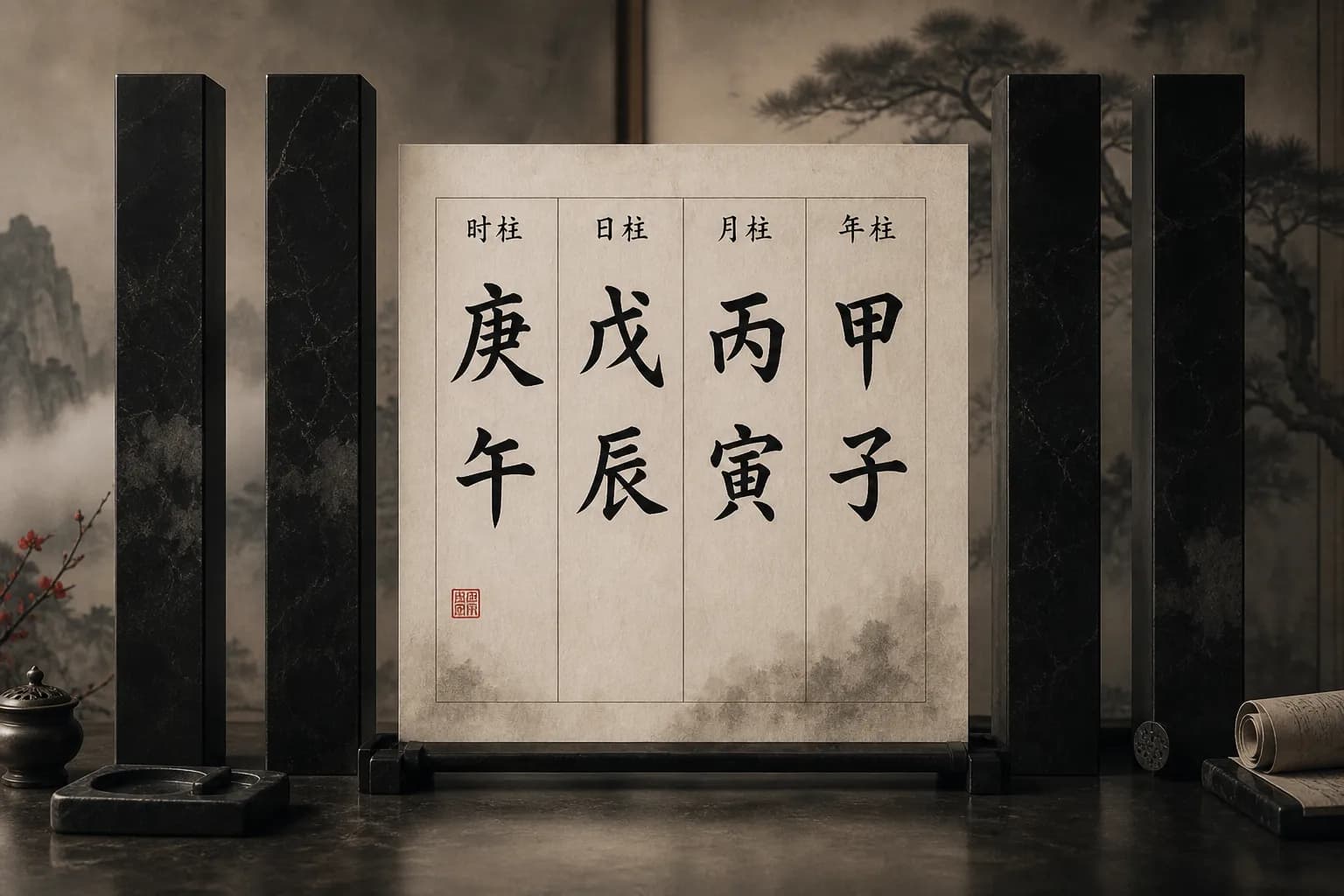
The Starting Time of Great Cycles (Qiyun Shijian) is the starting point for calculating the Great Cycles (Dayun) in Bazi (Four Pillars of Destiny) analysis. It marks the critical turning point where different stages of fortune transition in a person's life. Accurately calculating the Qiyun time is the foundational step for arranging the Dayun and predicting the auspiciousness or inauspiciousness of annual cycles (Liunian). It is also the bridge that extends Bazi analysis from a static birth chart to dynamic fortune trends. The calculation of Qiyun time involves core rules such as Yin-Yang (Yinyang) forward-reverse ordering principles and solar term (Jieling) reckoning. Every step requires rigorous attention, as any oversight may lead to deviations in subsequent predictions.
Basic Concepts of Qiyun
Qiyun refers to the age at which the person officially begins to experience the Great Cycles. In the Bazi system, each Dayun covers a ten-year period, representing the direction of fortune and changes in opportunities during different life stages. The period before Qiyun is called Childhood Fortune (Tongyun), which is typically inferred roughly using the Monthly Pillar as the baseline. After Qiyun begins, the Dayun cycles are arranged in forward or reverse order, with each pillar governing ten years of fortune. The Dayun interacts with the birth chart—either supporting or restricting it—together forming the trajectory of fortune throughout the person's life.
Yin-Yang Forward-Reverse Ordering Rules for Dayun
The core rule for arranging Dayun is determined by the combination of the Heavenly Stem (Tiangan) polarity of the Year Pillar and the native's gender. Specifically, for Yang year and Yang male, or Yin year and Yin female, the Dayun is arranged in forward order. For Yin year and Yang male, or Yang year and Yin female, the Dayun is arranged in reverse order. A Yang year refers to years with Heavenly Stems Jia (甲), Bing (丙), Wu (戊), Geng (庚), or Ren (壬). A Yin year refers to years with Heavenly Stems Yi (乙), Ding (丁), Ji (己), Xin (辛), or Gui (癸). Forward arrangement means ordering the Dayun sequentially after the Monthly Pillar; reverse arrangement means ordering sequentially before the Monthly Pillar. This rule originates from the principle of Yin-Yang waxing and waning, where forward and reverse represent different directions in which life energy unfolds.
Calculation Method for Qiyun Age
To calculate the Qiyun age, one must first precisely determine the time difference between the birth date and the nearest solar term. For forward arrangement, count the days from the birth date to the next solar term. For reverse arrangement, count the days from the birth date to the previous solar term. Divide the resulting number of days by three; the quotient is the Qiyun age, and the remainder is converted at a rate of one day equaling four months. For example, if the birth date is exactly thirty days from the solar term, then thirty divided by three equals ten, meaning Qiyun begins at age ten. If the difference is one day, then four months are added to the Qiyun time. When calculating, pay attention to the exact birth time, precise to the hour (Shichen).
Method for Arranging Dayun
The arrangement of Dayun strictly uses the Monthly Pillar's Heavenly Stem and Earthly Branch (Ganzhi) as the baseline. In forward arrangement, the Ganzhi after the Monthly Pillar follow the sequential order of Heavenly Stems and Earthly Branches. In reverse arrangement, the Ganzhi before the Monthly Pillar follow the reverse order. The Heavenly Stems follow the order: Jia, Yi, Bing, Ding, Wu, Ji, Geng, Xin, Ren, Gui. The Earthly Branches follow the order: Zi, Chou, Yin, Mao, Chen, Si, Wu, Wei, Shen, You, Xu, Hai. For example, if the Monthly Pillar is Bing-Yin (丙寅), the forward Dayun sequence is Ding-Mao (丁卯), Wu-Chen (戊辰), Ji-Si (己巳), Geng-Wu (庚午), etc. The reverse sequence is Yi-Chou (乙丑), Jia-Zi (甲子), Gui-Hai (癸亥), Ren-Xu (壬戌), etc. Each pillar governs ten years of fortune.
The Critical Role of Solar Terms in Qiyun
Bazi Dayun arrangement strictly uses solar terms as boundaries and never uses the first day of the lunar calendar or the Gregorian calendar New Year. The Year Pillar uses the Beginning of Spring (Lichun) as the boundary; the Month Pillar uses solar terms as boundaries; and Qiyun calculation also uses the Twenty-Four Solar Terms (Ershisi Jieqi) as the standard. Commonly used key solar terms include Lichun (立春), Jingzhe (惊蛰), Qingming (清明), Lixia (立夏), Mangzhong (芒种), Xiaoshu (小暑), Liqiu (立秋), Bailu (白露), Hanlu (寒露), Lidong (立冬), Daxue (大雪), and Xiaohan (小寒). Ignoring the exact moment of solar terms and relying solely on dates will very likely result in incorrect Dayun arrangement, causing the entire prediction direction to deviate.
Practical Application Notes
In actual chart plotting, special attention must be paid to the accuracy of the birth time. It is best to convert it to True Solar Time (Zhen Taiyang Shi) before calculating. For births occurring near solar terms, one must carefully verify the exact moment of the solar term against a perpetual calendar. A difference of one hour may change the entire chart result. Additionally, the Qiyun age is usually taken as an integer for rough estimation, but in fine-grained calculations, it can be combined with specific months for more precise positioning. Some Bazi schools also analyze the pre-Qiyun period by proportionally converting the Monthly Pillar according to age for Childhood Fortune analysis. Accurate Qiyun time is the prerequisite for subsequent annual cycle predictions and must be treated with the utmost care.