How to Read the Ten Gods From the Day Master
Use peers, output, wealth, officer, and seal roles to map resources, pressure, and expression.
How the Ten Gods (十神) Are Defined
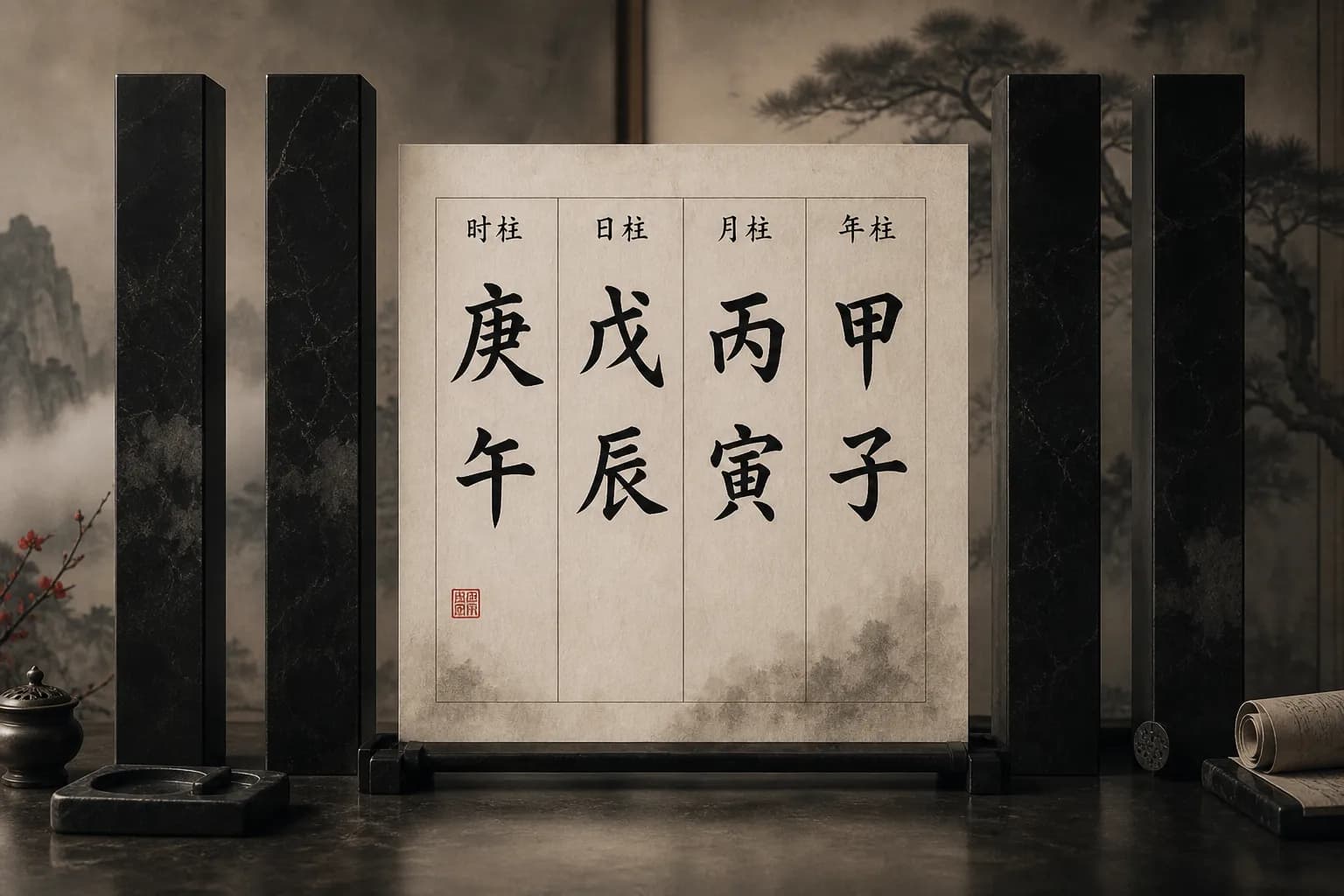
The Ten Gods (十神) are ten roles defined in Bazi (八字) destiny analysis based on the relationship between the other Stems and Branches and the Day Stem (日干, the Heavenly Stem of the birth day). The Ten Gods (十神) are: Bi Jian (比肩, Shoulder-to-Shoulder), Jie Cai (劫财, Robbing Wealth), Shi Shen (食神, Eating God), Shang Guan (伤官, Hurting Officer), Zheng Cai (正财, Proper Wealth), Pian Cai (偏财, Partial Wealth), Zheng Guan (正官, Proper Officer), Qi Sha (七杀, Seven Killings), Zheng Yin (正印, Proper Seal), and Pian Yin (偏印, Partial Seal). The core of the Ten Gods (十神) system lies in using the Day Master as a reference point to classify all the Five Element (五行) forces within the destiny chart according to their relationship with the Day Master, thereby constructing a map of a person's relationships with society, family, career, wealth, and other aspects.
Five Pairs of Comparison
The Ten Gods (十神) can be divided into five pairs, each containing two related but distinct deities:
Bi Jie (比劫, Shoulder-to-Shoulder and Robbing Wealth) Bi Jian (比肩) is a Heavenly Stem (天干) of the same Five Element (五行) and same Yin-Yang polarity as the Day Stem (日干); Jie Cai (劫财) is of the same Five Element (五行) but opposite Yin-Yang polarity. Bi Jie (比劫) represents the self, peers, friends, siblings, and competitive relationships. Bi Jian (比肩) tends toward cooperation and equality, while Jie Cai (劫财) carries a sense of contention and division. People with strong Bi Jie (比劫) in their destiny chart are usually independent, self-respecting, but may also be overly stubborn or competitive with others.
Shi Shang (食伤, Eating God and Hurting Officer)
Shi Shen (食神) is the Five Element (五行) generated by the Day Stem (日干) and of the same Yin-Yang polarity; Shang Guan (伤官) is generated by the Day Stem but of opposite Yin-Yang polarity. Shi Shang (食伤) represents talent, expression, creativity, interests, and children. Shi Shen (食神) tends to display talent in a gentle manner, while Shang Guan (伤官) is more intense and direct. People with strong Shi Shang (食伤) are usually intelligent, creative, but may also be sharp-tongued and unconventional.
Cai Xing (财星, Wealth Stars)
Zheng Cai (正财) is the Five Element (五行) controlled by the Day Stem (日干) and of opposite Yin-Yang polarity; Pian Cai (偏财) is controlled by the Day Stem and of the same Yin-Yang polarity. Cai Xing (财星) represents wealth, material resources, enjoyment, and emotional relationships (for men, also representing the wife). Zheng Cai (正财) tends toward stable income and legitimate wealth, while Pian Cai (偏财) represents unexpected wealth and movable assets. People with strong Cai Xing (财星) usually value material life and are good at managing money.
Guan Sha (官杀, Officer and Killings)
Zheng Guan (正官) is the Five Element (五行) that controls the Day Stem (日干) and of opposite Yin-Yang polarity; Qi Sha (七杀) is the Five Element that controls the Day Stem and of the same Yin-Yang polarity. Guan Sha (官杀) represent career, power, social status, constraints, and challenges (for women, also representing the husband). Zheng Guan (正官) tends toward legitimate power and stable status, while Qi Sha (七杀) represents pressure and competition. People with strong Guan Sha (官杀) are usually career-driven and responsible, but may also bear considerable pressure.
Yin Xing (印星, Seals)
Zheng Yin (正印) is the Five Element (五行) that generates the Day Stem (日干) and of opposite Yin-Yang polarity; Pian Yin (偏印) is the Five Element that generates the Day Stem and of the same Yin-Yang polarity. Yin Xing (印星) represent knowledge, wisdom, protection, benefactors, and the mother. Zheng Yin (正印) tends toward orthodox knowledge and stable shelter, while Pian Yin (偏印) represents special talents and unorthodox knowledge. People with strong Yin Xing (印星) are usually studious, thoughtful, and aided by benefactors.
Symbolic Meanings of the Ten Gods (十神取象)
Each of the Ten Gods (十神) not only has a definition based on generating-controlling relationships but also carries rich social symbolic meaning. Zheng Guan (正官) symbolizes rules and responsibility; Qi Sha (七杀) symbolizes pressure and breakthrough; Zheng Yin (正印) symbolizes knowledge and shelter; Pian Yin (偏印) symbolizes unique thinking; Shi Shen (食神) symbolizes talent and blessing; Shang Guan (伤官) symbolizes intelligence and rebellion; Zheng Cai (正财) symbolizes stable wealth; Pian Cai (偏财) symbolizes flowing opportunities; Bi Jian (比肩) symbolizes equal competition; Jie Cai (劫财) symbolizes contention and sharing.
Strength of the Ten Gods (十神力量)
The strength of the Ten Gods (十神) in a destiny chart depends on the waxing and waning of their corresponding Five Elements (五行), their positions (Heavenly Stem 天干 or Earthly Branch 地支), and whether they receive support from other elements. When the Five Element corresponding to a particular Ten God is in a flourishing state within the destiny chart, that Ten God's influence is strong; conversely, it is weak. The strength of the Ten Gods (十神) directly affects the native's performance and experiences in that area.
Combinations of the Ten Gods (十神组合)
The way the Ten Gods (十神) combine within a destiny chart determines the basic characteristics of the destiny pattern. For example, the combination of Shi Shang (食伤) generating Cai (财) is conducive to monetizing talent, suitable for creative and commercial work; the combination of Guan (官) and Yin (印) mutually generating is conducive to official career development, suitable for management and public service; the combination of Bi Jie (比劫) seizing Cai (财) calls for attention to financial management. Analyzing the generating-controlling relationships among the Ten Gods (十神) is one of the core methods of Bazi (八字) destiny analysis.