What's the Difference Between Transits and Your Natal Chart: How Birth Charts and Current Sky Work Together
Astrology · July 15, 2026
Most people's first encounter with astrology starts with "Mercury is retrograde." Then someone tells you you should look at your birth chart, so you pull one up. Then someone says you need to read transits alongside your natal chart, and you're lost—which one am I supposed to look at?
The answer is not one replacing the other. Your natal chart and transits are two different things that answer two different questions and apply in two different contexts.
The Natal Chart: Your Base Settings
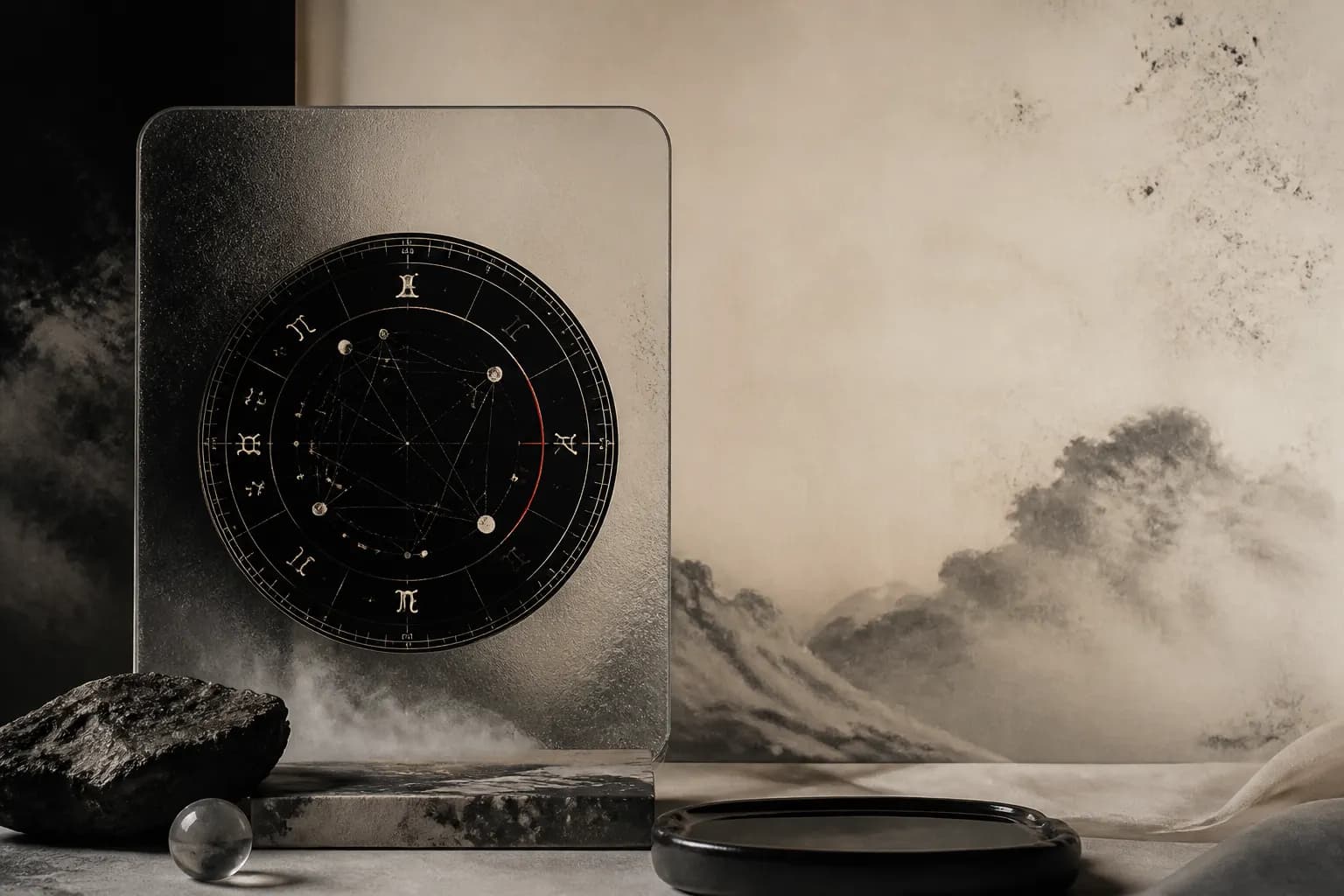
A natal chart is a map of where the planets were positioned on the zodiac at the exact moment you were born.
The core function of this chart isn't to tell you "what will happen in the future"—it describes your **foundational configuration** as a person. Which sign the Sun is in, which house the Moon falls in, whether Mars and Saturn form a hard aspect—these elements combine to sketch out an outline of personality tendencies, emotional patterns, action styles, and life themes.
Think of it this way: your natal chart is a building's blueprint. It marks where the load-bearing walls are (say, a Moon-Saturn square, meaning long-term emotional pressure), where the skylights are (say, a Sun-Jupiter trine, natural optimism and a knack for meeting helpful people), and where the basement is (say, a stellium in the twelfth house, with a lot of inner life that doesn't show easily). A blueprint doesn't tell you whether the building will catch fire today, but it tells you the structure—which parts can take a beating and which parts will crumble at the slightest push.
So in practice, your natal chart answers questions like:
- Where are my strengths and blind spots? - What are my emotional needs and stress patterns? - What types of events tend to trigger strong reactions in me? - What are my relationship patterns, work style, and decision-making tendencies like?
These questions have nothing to do with "how's my year going." They are traits that have always been part of you as a person, regardless of what year it is.
Transits: What's Happening in the Sky Right Now
The Chinese term "liúnian" (流年) is used loosely in Chinese astrology circles. Strictly speaking, it refers to the **current actual positions of planets in the sky**, and the aspect relationships those positions form with your natal chart. In Western astrology, the formal term is **Transits**.
The logic of transits is straightforward: right now Jupiter is in Gemini, and the Sun in your natal chart is in Sagittarius—Jupiter and the Sun form an opposition. That opposition is a "transit event." It means the current sky is exerting an expansive kind of tension on your Sun (sense of self, core drive).
The key point: **transits are dynamic**. The planets are always moving; transit aspects change day by day. The inner planets (Mercury, Venus, Mars) move fast, so transit aspects last only days to weeks—their effects are short-term and event-driven. The outer planets (Uranus, Neptune, Pluto) move slowly; a single transit aspect can last one to three years—their effects are long-term and structural.
Different planets have very different transit rhythms:
| Planet | Orbital Period | Transit Duration | Basic Meaning |
|---|---|---|---|
| Moon | 27–28 days | Hours to 2 days | Emotional fluctuation, short-term triggers |
| Mercury | ~88 days | Days | Communication, travel, mental rhythm |
| Venus | ~225 days | Days to a week | Relationships, aesthetics, values |
| Mars | ~687 days | Days to 2 weeks | Drive, conflict, energy |
| Jupiter | ~12 years | Months to a year | Expansion, opportunity, overoptimism |
| Saturn | ~29 years | Months to 2 years | Structural tests, responsibility, limitation |
| Uranus | ~84 years | 1–3 years | Sudden change, revolution, breaking old patterns |
| Neptune | ~165 years | 1–3 years | Dissolving boundaries, illusion and inspiration |
| Pluto | ~248 years | 1–5 years | Deep power restructuring, death and rebirth |
The Saturn Return (around ages 29–30 and 57–60) is the most famous life milestone in transit work. During your first Saturn Return, transiting Saturn returns to the exact position where Saturn was when you were born—this typically corresponds to a structural shift in life from "experimental phase" to "taking on adult responsibility." Not everyone who goes through a Saturn Return gets divorced or loses their job, but most people feel a pressure of "I can't just coast anymore."
The Relationship: Natal Is the Canvas, Transits Are the Paint
This is where things get most confusing.
Many people think reading transits means checking "is this a good year for me," and reading the natal chart means "what's my personality." Neither understanding is exactly wrong, but both miss the point—**transits and the natal chart are not two separate systems; they are two layers of the same system**.
The natal chart defines your sensitive zones and response patterns. Transits tell you which external energies are currently touching those zones.
The same transit landing on different people's charts produces completely different effects. For example, transiting Pluto square natal Venus—if your natal Venus is in good condition (dignified, well-aspected), this transit might manifest as a power restructuring within a deep relationship—painful but with growth. If your natal Venus is already struggling (detriment, afflicted), the same transit might bring manipulation, a sense of betrayal, or a collapse of self-worth in relationships.
This is why an astrologer must thoroughly understand the natal chart before analyzing transits. Trying to read someone's transits without understanding their foundational structure is like looking at a building without knowing where the load-bearing walls are and saying "so how will this earthquake go?"—you don't even have a basis for judgment.
In astrological terms, this process is called **transits activating natal sensitive points**. Hard aspects in the natal chart (squares, oppositions)—especially those involving personal planets (Sun, Moon, Mercury, Venus, Mars) and the four angles (Ascendant, Descendant, Midheaven, IC)—are the positions most easily "activated" by transits. When a transiting planet passes exactly over one of these points, that tension that has always existed in the natal chart suddenly becomes impossible to ignore.
A Practical Approach to Reading Them Together
If you already have a natal chart and want to start paying attention to transits, here's a step-by-step approach:
Step 1: Identify the Key Points in Your Natal Chart
Not every point in the chart is equally important. Prioritize these:
- **Sun**: Core self, vitality - **Moon**: Emotional needs, sense of security - **Ascendant and chart ruler**: How you present outwardly, overall life direction - **Existing hard aspect focal points in the natal chart**: The apex of a T-square, or the midpoint of an opposition
These are the "lightning rods" on your chart—the places where you feel transits most intensely.
Step 2: Check Transit Aspects to These Points
You don't need to look at every transit of every planet. Prioritize:
1. **Hard aspects from outer planets (Pluto, Neptune, Uranus) to natal Sun and Moon**—these are life-level transits with far-reaching impact, worth preparing for in advance. 2. **Aspects from Saturn to natal key points**—structural tests, usually accompanied by increased pressure and responsibility. 3. **Aspects from Jupiter to natal key points**—expansion and opportunity, but watch for overoptimism. 4. **Inner planet transits**—useful for short-term planning, don't take them too seriously.
Step 3: Distinguish Triggers from Background
An important distinction in astrology: transits divide into **applying aspects** (the planet is moving toward the exact aspect) and **separating aspects** (the planet is moving away from the exact aspect). The energy of an applying aspect is still building; things haven't fully unfolded yet. The energy of a separating aspect is dissipating; the person is usually already in a phase of digesting and integrating.
Simply put: applying is "not yet," separating is "already past." If you make a major decision during an applying aspect, you're facing an uncertain, still-forming force. If you look back during a separating aspect, you already have some experience to help you understand what just happened.
Step 4: Don't Look Only at Transits
Transits are only one technique among predictive methods. Modern astrology typically combines several:
- **Secondary Progressions**: A symbolic "one day equals one year" ratio applied to the natal chart, reflecting the rhythm of inner psychological growth. The progressed Moon changes signs roughly every 2.5 years, making it an excellent tool for tracking shifts in your underlying emotional tone. - **Solar Arc Directions**: All celestial bodies in the natal chart are advanced by the same arc as the progressed Sun, looking for precise trigger points. - **Solar Return**: A new chart cast each year when the Sun returns to its exact natal position, used to determine the overall theme for the coming year.
When transits and progressions simultaneously point to similar themes, the likelihood in that area is highest. For instance, if transiting Pluto is squaring your natal Sun while your Solar Arc Moon is also conjoining your natal Sun—this kind of "multiple testimony" stacking usually means something significant will indeed happen during that period.
But if only one technique points to something, don't jump to conclusions. A single indicator doesn't equal an inevitable event.
Some Common Misconceptions
"Saturn Transits Are Always Bad"
Saturn transits do bring pressure and tests, but "bad" is a reductive way to understand pressure. The essence of Saturn's energy is **contraction, focus, facing consequences**. For someone whose natal Saturn is in good condition, a Saturn Return might just be a career-level upgrade in responsibility, not a disaster. Treating Saturn as uniformly malefic is one of the most stubborn oversimplifications in classical astrology; modern astrology (especially the humanistic school) corrected this long ago.
"Jupiter Transits Are Always Good"
Likewise, Jupiter expansion doesn't equal "good thing." When Jupiter transits natal Mars, energy is indeed strong—but if the direction is wrong, strong energy becomes reckless impulsiveness. Jupiter's "luck" requires your active cooperation to cash in—it opens the door, but it won't walk through it for you.
"My Transits Are Terrible, Be Careful"
Transits describe energy states, not predetermined events. Someone with Pluto opposing their Sun won't necessarily experience a "devastating event," but they're very likely to go through a deep disruption of self-understanding. Whether that disruption is good or bad depends largely on the person's level of awareness and how they respond.
This isn't about downplaying the force of transits—Pluto square the Sun genuinely doesn't feel good. But there's a big space between "doesn't feel good" and "disaster."
"People with Bad Natal Charts Have Bad Luck"
Natal charts don't come in "good" or "bad." A chart with many hard aspects does mean more tension and conflict in that person's life—but at the same time, tension is the engine of growth. Dane Rudhyar repeatedly emphasized: **without conflict, there is no awakening of consciousness**. People with lots of harmonious aspects might have smooth lives, but they might also lack depth and the drive for transformation.
A Quick Diagnostic Framework
If you just want to get a quick read on the overall tone of current transits without doing a full predictive analysis, keep an eye on these indicators:
- **What is transiting Saturn touching in the natal chart?** → Where your current pressure is. - **What is transiting Jupiter touching in the natal chart?** → Where your current opportunities are. - **Are any outer planets (Uranus, Neptune, Pluto) exactly aspecting natal Sun, Moon, or the four angles?** → If yes, you're in a life-level transition. - **What sign and house is the progressed Moon in?** → Your emotional tone for the next 2–3 years.
You don't need precise calculations for any of these—any astrology app can pull them up. They can't make decisions for you, but they can help you understand "why have I been feeling this way lately"—and that understanding is valuable in itself.
Finally: The Chart Is a Map, Not a Script
Whether you're using your natal chart or transits, what astrology offers is always a **framework for understanding tendencies**, not a prophecy of events.
Your natal chart tells you how your ship was built—where it's sturdy, where it's vulnerable, whether it rides the wind or the waves. Transits tell you what weather systems are moving across the sea right now—where the storms are, where the tailwinds are, which way the current flows.
But how you sail the ship is ultimately up to the sailor.
The value of astrology lies in helping you see "which point of yours is being touched by the sky right now," and "what your innate response pattern to that point is." See those two layers clearly, and you have an understanding far deeper than "is this a good year or not"—you understand yourself, not your fate.