How to Read a Three-Card Tarot Spread: It's Not Just Past, Present, Future
Tarot · July 15, 2026
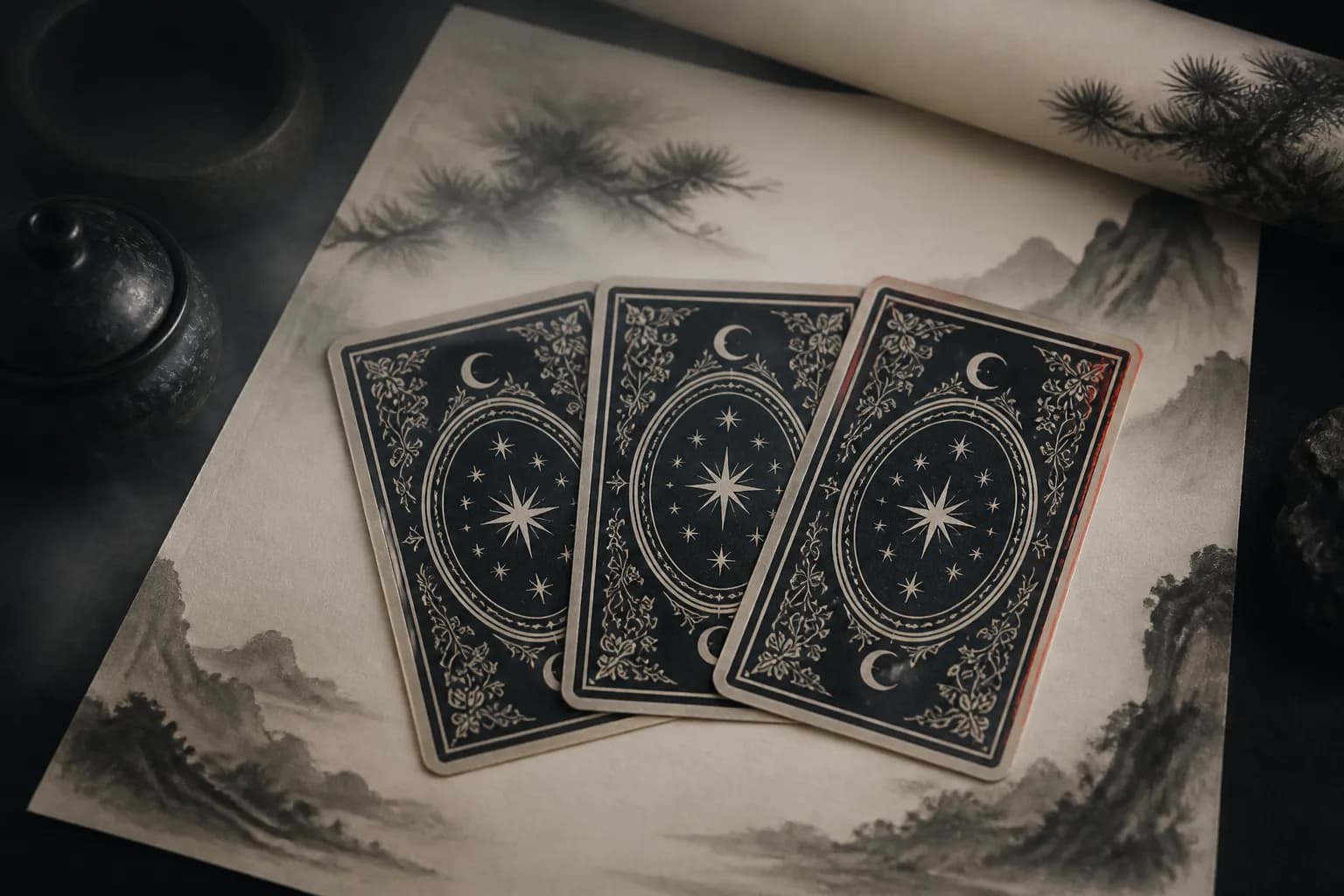
Most people's first encounter with tarot spreads is the three-card layout — past, present, future, three cards laid out left to right, simple and intuitive, like a story line. This intuition isn't wrong: the core of the three-card spread really is about giving a question a line — letting scattered card meanings flow in a direction, forming a readable narrative.
But the problem also lies right there. Most people have only ever seen the "past–present–future" application of three cards, so they assume that's all a three-card spread can do. That's a significant waste. The reason the three-card spread is the most universal framework in tarot isn't because it's the simplest — it's because its structure can support nearly any type of question. You just need to redefine what each position represents.
What Three Cards Are Actually Doing
Step back first. What is a spread actually doing?
Tarot cards themselves carry 78 distinct meanings — 22 Major Arcana plus 56 Minor Arcana, each with its own symbolic system and traditional interpretation. But these meanings are **floating.** You draw the Star — "hope, healing, inspiration" — and then what? In what context? Answering what question? Until you answer these, the card's meaning is just a pile of adjectives with nowhere to land.
What a spread does is **anchor context** for card meanings. You define three positions, each with a semantic role. When a card falls into a position, the card's meaning intersects with the position's meaning — producing a specific, directional piece of information.
This is similar to grammar. Words (card meanings) have dictionary definitions on their own, but to build a sentence (a spread), you need grammatical structure (position definitions) to organize words into meaningful expressions. The same word in subject position versus object position means something entirely different. The three-card spread is a three-part syntactic framework — the shortest possible, and therefore the most flexible.
Past–Present–Future: Useful, but Not Universal
The timeline spread is the standard entry point, for an intuitive reason: humans naturally habituate to understanding events through temporal narrative. "How did I get here? What's happening now? What comes next?" — these three questions are almost a reflexive response to any dilemma. The three-card spread maps perfectly onto this cognitive pattern.
But the timeline has a structural weakness: **it implies an assumption you may not need — that the problem unfolds through time.**
Some problems genuinely unfold in time: "I recently changed jobs — will the new direction be better than where I am now?" "Can this relationship last much longer?" — these have a clear temporal dimension, and past–present–future fits naturally.
Others don't: "What's the core tension in my relationship with him?" "Faced with this choice, what are my internal fears versus external opportunities?" — the structure of these questions isn't a timeline, it's dimensional partitioning. Forcing a past–present–future frame often makes interpretation strained: you might need to cram "core tension" into the "present" slot, and wedge "fear" and "opportunity" into "past" and "future" respectively. It can be done, but there's a structural mismatch between position semantics and question structure, and interpretation precision inevitably drops.
**So the first thing: determine whether your question actually suits a timeline.** If the problem genuinely has a temporal dimension, use it. If it doesn't, use a different position definition. The three-card spread doesn't become useless just because you abandon the timeline — it's far more versatile than most people realize.
Four Practical Position Definitions
Beyond the timeline, at least three other three-card position definitions hold up in practice.
Problem–Advice–Outcome
[The problem you face] [Suggested action] [Likely result of that action]
The core of this position set is **action orientation.** It doesn't care about "how you got here" (that's the past position's job). It focuses directly on "what should I do now."
Its strength: the middle card (advice) is the most actionable information. Most querents aren't there to hear analysis — they're looking for direction. The "present" position in a timeline spread tells you "what your current state is," but a state description isn't an action recommendation. You might see the Eight of Swords in the present position and interpret "you feel trapped" — accurate, but then what?
The problem–advice–outcome framework skips the state description entirely and gives you something executable: **do this, and that will likely happen.** It's particularly effective for decision-type questions: "Should I accept this offer?" "Should I move to another city?" "Should I keep this relationship going?"
One caveat: the "outcome" position is easily read as prophecy. But it isn't. Like all spreads, it's a projection based on current patterns — if you take the direction implied by the advice card, what's the most likely trajectory. Change the action, the outcome changes. This qualification is worth stating explicitly in the reading, so the querent doesn't take a Ten of Cups as a guarantee of happiness.
Self–Other–Relationship
[Your state/perspective] [The other's state/perspective] [The dynamic between you]
This position set is purpose-built for relationship questions. Its structure isn't a narrative — it's **triangulation** — the first two cards describe the internal state at each end, and the third describes the field generated between them.
In practice, the difficulty with this definition is that the first and second cards need to be as objective as possible. But the querent's description of "self" naturally carries a subjective filter, and their description of "the other" easily becomes projection. A reversed Tower appearing in the "other" position, the querent might immediately read as "they're going to destroy everything" — but you'd need to consider another possibility: the querent themselves fears being hurt and is projecting that fear onto the other person's card.
This doesn't mean the position definition is flawed — it means relationship spreads are more dependent on the reader's sensitivity to projection than other types. If you find the first two cards both trending toward extreme interpretations, it might be worth pausing to ask: "How much of what you feel about the other person is based on what you've actually observed, and how much is based on what you're afraid of?"
Body–Mind–Spirit (or Material–Emotional–Meaning)
[Material/practical layer] [Emotional/psychological layer] [Meaning/spiritual layer]
The structure here is **layered scanning.** It doesn't narrate, doesn't advise — it simply slices the same question through three different depths.
For example, someone asks "Should I quit my job to start a business?" — the timeline would give an evolutionary arc; problem–advice–outcome would give an action plan. But layered scanning provides a different kind of information: "Looking at the material layer, what's your financial situation and practical readiness? Looking at the emotional layer, what's your real feeling about this — excitement or anxiety? Looking at the meaning layer, does this align with your long-term understanding of your life?"
The three layers might contradict each other — the material layer shows the Four of Pentacles (unstable financial foundation), the emotional layer shows the Ace of Wands (intense enthusiasm and drive), the spiritual layer shows the Wheel of Fortune (a sense that "this is the right timing"). Contradiction isn't a problem — it's often the most valuable material in the reading: it tells you this can't be simply answered with a yes or no, but requires you to hold multiple truths at once — the material risk is real, the enthusiasm is real, the sense of meaning is real. **How to choose among three competing truths — that's what you actually have to do after the cards are put away.**
The Fourth: Custom
The three above plus the timeline cover most scenarios. But three-card spreads aren't limited to these templates — you can define your own semantic roles for each position based on the question.
For instance, someone asks "I'm stuck in a creative block": - First position: what's causing the block - Second position: a resource you're overlooking - Third position: the direction of breakthrough
Or "I don't know whether to choose A or B": - First position: the core drive and risk of choosing A - Second position: the core drive and risk of choosing B - Third position: the underlying issue you need to face regardless of which you pick
**The key to custom positions: the three positions need to have a logical relationship — don't just grab three random dimensions and call it a spread.** Good position combinations are either progressive (cause → core → result), parallel (three comparable dimensions), or two-ends-plus-synthesis (A's state → B's state → the dynamic between them). As long as the relationship is clear, three cards can form a readable information chain.
The Relationships Between Cards Matter More Than Any Single Card
Regardless of which position definition you use, the most common mistake in three-card reading is **card-by-card interpretation** — saying what the first card means, then the second, then the third, and adding "overall…"
This isn't reading. It's reading a menu.
When three cards sit together, the truly valuable information isn't in any single card's independent meaning — it's in the **relationships between the cards.** Several relationship patterns worth watching:
**Contrast.** The difference between the first and third cards is the most obvious narrative engine. A Two of Swords (indecision) in the past position and the Emperor (authority and decisiveness) in the future position create strong contrast — the story arc is "from hesitation toward resolve," and the middle card should tell you how this transformation happens. If the middle card is the Fool, the reading direction is "you need to take a risk to break the hesitation"; if the middle is the Hermit, it's "you need solitude to figure out what you actually want." The same contrast, a different middle card, produces a completely different story.
**Repetition or emphasis.** When the three cards share the same number, the same suit, or the same character theme, that card's meaning is amplified. Three Cups, and the emotional dimension dominates the question overwhelmingly — regardless of whether you're asking about romance. Two eights — the Eight of Pentacles and the Eight of Swords — and the theme of eight ("discipline, refinement, approaching completion") spans two elements (earth and air), suggesting that material and psychological layers are both undergoing similar trials.
**Progression.** The numbered Minor Arcana have a built-in progression — Ace to Ten of Wands traces a path from inspiration to realization. If the three cards show ascending numbers (say the Two, Five, and Eight of Cups), it suggests an evolution "from simple to complex." Descending numbers suggest convergence or release.
**Elemental tension.** Fire (Wands) next to Water (Cups) suggests friction between action and emotion — a gap between what you want to do and what you actually feel. Earth (Pentacles) next to Air (Swords) suggests tension between practical reality and ideals. This elemental analysis is especially useful in timeline spreads: if the past is earth, present is air, and future is fire, it implies an evolution from "stable reality" to "thinking and planning" to "taking action." Reversed — past fire, present air, future earth — implies "impulsive action" → "reflection and digestion" → "landing and grounding." A completely different story.
The Middle Card Is the Pivot
However you define the positions, the middle card in a three-card spread is almost always the interpretive pivot.
In the timeline, the middle is "present" — the bridge connecting past context and future trajectory. In problem–advice–outcome, the middle is "advice" — the only card that directly offers a direction of action. In self–other–relationship, the middle is "relationship dynamic" — the two ends are inputs, the middle is the answer you actually wanted.
This structure isn't accidental. Three-part narrative naturally centers weight on the middle — it connects what came before and what comes after, making it the position with the highest information density. If you're going to study only one card in a three-card spread, make it the middle one. Its information usually covers the majority of the spread's meaning.
This doesn't mean you should ignore the ends. The ends provide context for the middle — a pivot without context is isolated advice. With context, you can understand what question the advice is answering. The full reading process: first scan all three cards for the overall picture (color tone, number of Major Arcana, ratio of upright to reversed), then examine the contrast or progression between the two ends, and finally focus on the middle card, placing it within the understanding framework built by the first two layers to extract specific, directional information.
A Practical Example
Question: "I'm thinking about ending a friendship that's lasted two years. This relationship exhausts me, but I'm afraid I'll regret it."
Position definition chosen: problem–advice–outcome (this is a decision-type question, so action orientation fits better than a timeline).
| Position | Card drawn | Initial associations |
|---|---|---|
| Problem | Five of Cups (upright) | Loss, grief, mourning something that was once present but is no longer |
| Advice | Two of Swords (upright) | Difficult choice, deadlock between two options, needing to decide but unable to |
| Outcome | Wheel of Fortune (upright) | Turning point, cycles, things naturally shifting to the next phase |
**Overall picture:** No reversed cards among the three — the overall energy isn't blocked. It's more like being at a turning point. Only one Major Arcana (Wheel of Fortune), suggesting this matters for your life trajectory but isn't existentially defining. Element distribution: Cups (water) + Swords (air) + Major Arcana — both emotion and intellect are involved, but the material layer (Pentacles) and action drive (Wands) are absent — indicating this dilemma lives primarily in the realm of feeling and thinking, not yet translated into concrete action.
**Problem position (Five of Cups):** Your dilemma is essentially a grief — not anger or disappointment at a specific event, but mourning the loss of "it used to be good but now it isn't." In the Five of Cups, five cups are spilled and only one remains standing — you're still holding onto something you don't want to let go of. This aligns with what you said: you're afraid of regret. The imagery of the Five of Cups is saying: you've already started rehearsing regret before it's even happened.
**Advice position (Two of Swords):** This card *is* the difficulty of choosing — arms crossed, eyes blindfolded, two swords. It's telling you: your current state is deadlock. Not "no options," but "I can see the cost of both options, so I stay frozen." The key information of the Two of Swords: **deadlock is not safe neutrality — it's the energy drain of a delayed decision.** You're not "not choosing" — you're "choosing not to choose," and not choosing has its own cost (which is what you describe as feeling "exhausted").
**Outcome position (Wheel of Fortune):** The Wheel of Fortune in the outcome position has two layers. One: regardless of what you choose, things will naturally shift to a new phase — this relationship won't stay in its current state forever. Two: the Wheel implies **cyclical change** — ending doesn't mean permanent disappearance. It might just be the end of this relationship's current form.
**Synthesis:** The story the three cards tell together — you're mourning a relationship that has lost its vitality (Five of Cups), and this mourning has you locked in the choice of "whether to let go" (Two of Swords), but the overall message of the spread is: transition will happen naturally, and this transition isn't necessarily the absolute ending you fear (Wheel of Fortune).
The real judgment isn't "should I end it or not," but: **is the energy you're burning through deadlock already exceeding the nourishment this relationship still provides?** The five spilled cups in the Five of Cups won't stand back up on their own — only one remains standing. Sometimes "fear of regret" isn't intuition warning you — it's grief stalling you.
This reading doesn't give a simple "end it" or "don't end it." Three-card spreads don't need to provide binary answers — they provide information: what emotion you're actually processing, what your behavioral pattern is right now, and what's most likely to happen if you maintain the status quo. The choice, after that, is yours.
A Three-Card Spread Isn't a Simplified Big Spread
There's a view that three-card spreads are "beginner's simplified versions" and serious reading should use the Celtic Cross or more complex layouts. This is half right — three-card spreads are indeed simple, but simple doesn't mean shallow.
A three-card spread's information density depends on three factors: the precision of your position definitions, the reader's familiarity with card meanings, and — the most easily overlooked — the quality of the querent's question. With the same level of question vagueness, a ten-card spread gives you ten times the vague information; a three-card spread only gives you three times. The latter is actually easier to work with.
If you want to develop your reading skills, three-card spreads are a better training ground than large spreads. The reason: large spreads carry so much information that beginners get overwhelmed and default to card-by-card listing. Three-card spreads force you to focus on **relationships** rather than **individual cards** — you can't coast on reciting card meanings; you have to see the narrative between three cards. Once that skill is developed, it transfers to any complex spread.
---
*Tarot isn't a fortune-telling tool. It's a way to structure vague feelings and dilemmas. The three-card spread is the most compact structure in the system — three lines of signal, compressing chaos into readable information. What you do with it after reading — that's entirely up to you.*