How to Judge Day Master Strength in Bazi: Don't Turn Yourself Into a Label
Bazi · July 15, 2026
If you've ever looked up your Bazi chart online, you've almost certainly seen conclusions like these: "Your Day Master is weak and lacks Fire — wear more red." "Strong Wood destiny, decisive but prone to stubbornness." One sentence, and they've summed you right up.
But what does "weak Day Master" actually mean? Weak in what dimension? And so what? Most "free chart reading" websites won't answer these questions — because if they did, they'd have to admit that things are far more complicated than three words.
This article focuses on the most fundamental and most easily misused step in Bazi analysis: **judging the strength of the Day Master.** I'll explain how tradition assesses it, why different schools reach different conclusions, and what role "strong versus weak" actually plays in the analytical chain.
Bottom line first: **Day Master strength is the starting point of a reasoning chain, but this step itself is riddled with disagreement. Treating it as a settled label to slap on a person is a misuse of the system.**
The Day Master: The One Character in Eight That Points to "You"
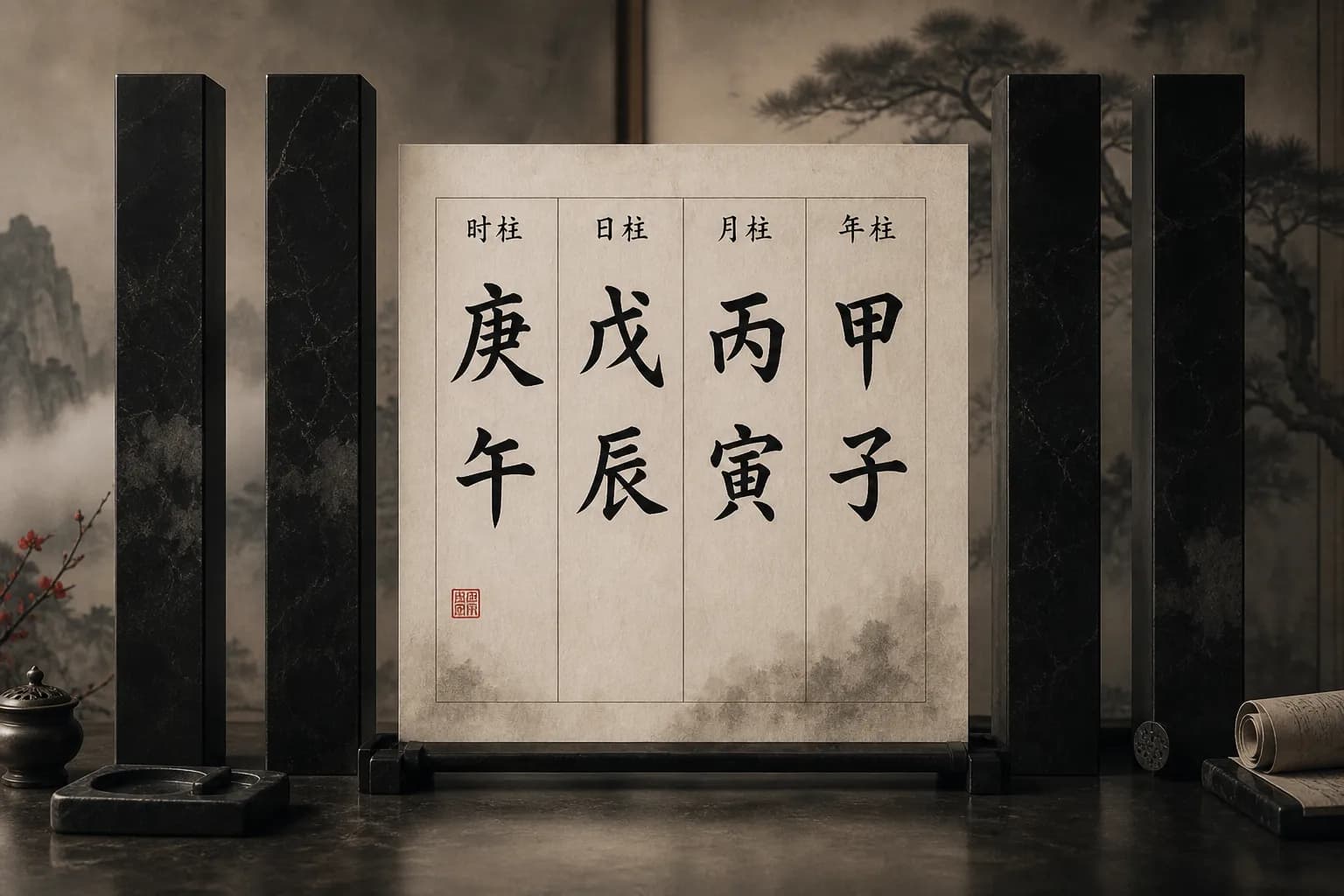
The four pillars of a Bazi chart contain eight characters in total. The Heavenly Stem of the Day Pillar — the Day Stem — is the Day Master. It is the reference point for the entire analysis.
Among the eight characters, the Day Stem represents "self." The other seven characters are "self's" environment: what generates me, what overcomes me, what I generate, what I overcome, and what is of the same category as me — each with its own role. This relational network centered on the Day Stem is the Ten Gods system (to be covered in the next article).
Why the Day Stem and not the Year Stem or the Hour Stem? The Song dynasty Ziping method established the Day Stem as the analytical core, and it has a logic to it: the Year Pillar governs the year, the Month Pillar governs the month, the Day Pillar narrows down to a specific day — among the four time granularities, the Day Pillar is the only one that naturally corresponds to the "individual" level. The earlier Tang dynasty Li Xuzhong's Three-Pillar method had no explicit concept of a "master." The selection of the Day Stem as center represents an important convergence in the development of Bazi numerology.
"Convergence" does not mean "perfection" — it simply means this is the scheme with the widest acceptance today. The Day Stem selection itself is not without dispute, but among all options, it has the strongest practical utility.
Three Dimensions of Strength: De Ling, De Di, De Shi
Traditionally, Day Master strength is assessed along three dimensions.
**De Ling (Seasonal Support):** Is the Day Master's element in its prosperous season? Jia Wood born in spring (Yin or Mao month) is De Ling; born in autumn (Shen or You month), it is Shi Ling (out of season). The Monthly Decree provides the Day Master with the most basic seasonal backdrop — Wood prospers in spring, Fire in summer, Metal in autumn, Water in winter. This is the mapping of natural rhythms into the Bazi system.
**De Di (Rootedness):** Does the Day Master have "roots" in the Earthly Branches? Jia Wood seeing Yin in the branches (Yin contains Jia Wood as its primary qi) means it is rooted. If no branch in the four pillars contains any Jia Wood hidden stem, then Jia Wood is "empty and unrooted" — its strength is not grounded. Roots have depth: primary qi roots are strongest, middle qi next, residual qi weakest.
**De Shi (Momentum):** Are there same-element characters among the Heavenly Stems to support the Day Master? Jia Wood seeing other Stems that are also Jia or Yi means companion assistance — this is De Shi.
All three dimensions satisfied → Day Master leans strong. None satisfied → Day Master leans weak. Most people's charts fall in the gray middle ground — some dimensions have support while others are deficient, requiring综合judgment.
This judgment framework itself is not controversial. The controversy lies in **how to weight the three dimensions against each other.**
Monthly Decree Weighting: No Unified Answer
The traditional mainstream view is that the Monthly Decree is the most important factor — it provides the Day Master with the most fundamental seasonal baseline. But "how much more important" varies wildly between schools.
Some approaches place the Monthly Decree in an absolutely dominant position, arguing that whether the Day Master is in season or not sets the tone, with rootedness and momentum serving only as fine-tuning. Others argue that the weight gap between the three dimensions isn't as large as imagined — for example, even if the Day Master is out of season, if all four pillars are full of roots and the Stems are crowded with companions, the Day Master can still lean strong.
A more radical perspective comes from schools like the Blind School: they argue that strength-weakness shouldn't be overemphasized — just look at structure and Ten Gods combinations, and treat strength-weakness as rough background information. This criticism has some merit — when you spend enormous effort debating "is this Day Master slightly strong or slightly weak," the structure and Ten Gods combinations may already have given you more direct analytical leads.
I'm not going to take sides here, because **the debate over Monthly Decree weighting reflects a deeper tension: should analysis enter through force assessment or through structural analysis?** This question will come up again in the discussion of structural patterns.
Strong and Weak Are Not Good-or-Bad Labels
The most common misunderstanding: strong equals good, weak equals bad.
Wrong. Strong and weak are neutral descriptors — they describe the Day Master's force state within the chart, not a quality score for someone's life.
A strong Day Master has abundant force and can absorb more depletion (Wealth Stars, Officer/Killer Stars, and Food/Wound Stars all deplete the Day Master). A strong Day Master benefits from periods of depletion — use Wealth, Officer, and Food/Wound to release excess force. But if the Day Master is excessively strong, with nothing to restrain it, this can manifest as stubbornness, ego inflation, and refusing to listen.
A weak Day Master has insufficient force and needs generating and supporting (Resource Stars, Companions). A weak Day Master benefits from Resource or Companion periods — having others help and resources provided can make them better at seizing opportunities than a strong Day Master. Being weak doesn't mean "bad fate" — it means **the Day Master needs external support to function effectively.**
So the key isn't strength or weakness itself, but **favorable and unfavorable elements:** what a strong Day Master needs, what a weak Day Master needs. The favorable-unfavorable judgment is the real output of strength analysis — and it directly affects the selection of the Useful God and the auspicious-inauspicious analysis of major life periods and annual cycles.
Remember one thing: **Strong or weak Day Master determines what kind of environment you need to perform at your best — not whether you're a good person or not.**
A Reasoning Chain That Fractures Easily
Why does Day Master strength judgment matter so much? Because it's the starting point of an entire reasoning chain:
**Day Master strength → favorable-unfavorable judgment → Useful God selection → Ten Gods relationship interpretation → major period and annual cycle analysis**
At every step of this chain, correctness depends on the step before it. If the strength judgment goes wrong, the favorable-unfavorable analysis, Useful God, and Ten Gods interpretation all shift — and the further down the chain, the larger the deviation.
An example. A Jia Wood Day Master born in winter (Water prosperous, Wood resting), with Hai and Zi Water in the branches, Bing and Ding Fire and Geng and Xin Metal in the Stems. If you only see "Wood is weak in winter" and judge it as weak, favoring Water and Wood — but Bing and Ding Fire are draining Wood's force, Geng and Xin Metal are overcoming Wood, and on top of that the Water in the branches carries the risk of "too much Water floating Wood" — the Day Master may not actually be weak at all. Different foundational assessments lead to completely opposite favorable-unfavorable conclusions.
This is why strength judgment can't be reduced to "just look at the Monthly Decree" — the Monthly Decree is the starting point, but you must combine it with the global picture of branch rooting and Stem interactions. Ignore any layer, and the reasoning chain fractures at that point.
Structural Pattern Theory's Challenge: Strength Isn't the Only Entry Point
The strength-weakness judgment described above is essentially the "Support-Restrain Method" approach: first assess Day Master strength, then use generating or draining to achieve balance.
But the Structural Pattern Theory pioneered by Shen Xiaozhan in *Zi Ping Zhen Quan* takes a different path: **first look at what Ten God is hidden in the Monthly Decree, define the pattern around that Ten God, then analyze whether the pattern succeeds or fails.** In Structural Pattern Theory, Day Master strength is a supporting role; the Pattern Useful God (the Ten God that maintains the pattern's integrity) is the protagonist.
This isn't just a difference in analytical sequence — it's a difference in analytical philosophy:
- The Support-Restrain Method asks: **Where is the Day Master's balance point?** - Structural Pattern Theory asks: **What is the structural core of this chart?**
Pattern Theory advocates criticize the Support-Restrain Method for being too focused on balance and ignoring structure — like evaluating a company by looking only at its balance sheet, not at what business it does. Support-Restrain supporters counter that Pattern Theory ignores the Day Master's own carrying capacity — a great pattern means nothing if the Day Master is too weak to bear it.
Both perspectives have merit and should both be considered in a complete analysis. If you see an interpretation online that only emphasizes strong or weak Day Master, or only discusses pattern success and failure, completely ignoring the other dimension — it's probably doing a selective simplification.
The Day Master Is a Starting Point, Not a Label
Back to the original question: what does "weak Water Day Master" actually mean?
It means: in this chart, the character representing you, under a combined assessment of season, rooting, and Stem support, has relatively weak force. It tells you that you might need Resource Stars and Companions more than average to fulfill your potential.
It does **not** mean you're weak-willed, have a bad destiny, or need to wear red to supplement Fire. Those conclusions require multi-layered analysis — Ten Gods, pattern, favorable-unfavorable elements, major periods and annual cycles — built on top of the strength judgment, and each layer can have its own disagreements.
Treating Day Master strength as a label to slap on yourself is like reading a book's table of contents and claiming you've read the book. The table of contents matters, but the story comes after.