How the Ten Gods Read Relationships: A Role Map, Not Jargon
Bazi · July 15, 2026
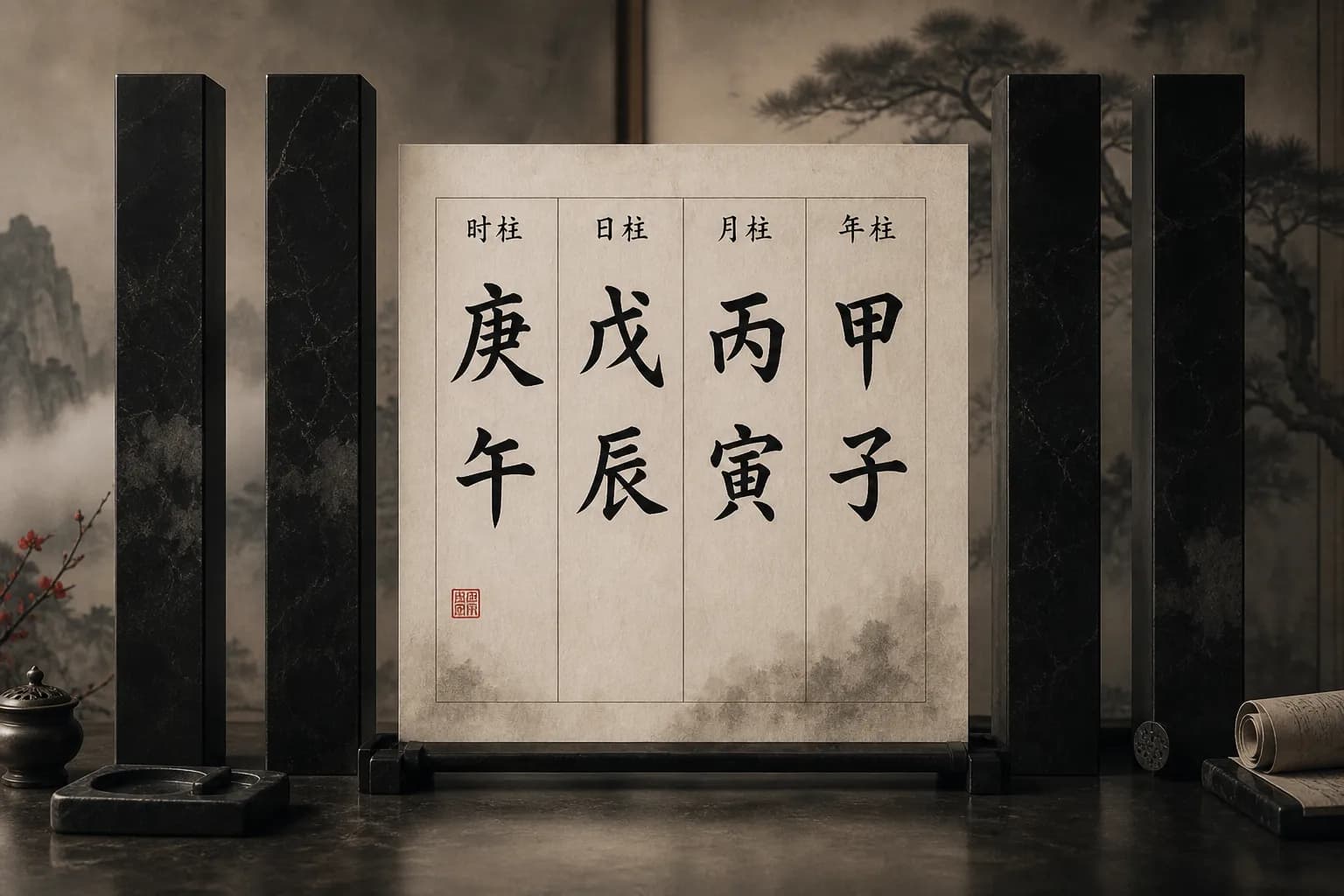
"Direct Officer in the destiny chart means career success." "Hurting Officer meets Direct Officer — disaster." "Indirect Wealth in the chart means strong romantic appeal." If you've encountered Bazi, you've probably seen lines like these. They sound like a code: match each term to its meaning and you can read someone's fate.
That's not how the Ten Gods work.
The Ten Gods' core function isn't labeling each character in the chart and looking up definitions. They are Bazi's only **relational mapping system** — they translate Five Element interactions among the eight characters into interpersonal dynamics, behavioral patterns, and situational tensions. The way to understand the Ten Gods isn't memorizing definitions; it's understanding how they turn abstract generation-and-restriction relationships into scenarios you can actually see in life.
This piece covers three things: how the Ten Gods are derived, what the Direct/Indirect distinction actually means, and why Ten God combinations matter far more than individual Ten Gods.
Two Dimensions, Ten Roles
The derivation of the Ten Gods is remarkably clean. For any Heavenly Stem or Earth Branch hidden stem, only two attributes need to be determined relative to the Day Master:
**Five Element relationship**: What is its relationship to me — does it generate me, restrict me, do I generate it, do I restrict it, or is it the same as me?
**Yin-Yang polarity**: Is it the same polarity as me or different?
Five element relationships, two polarities: 5×2 = 10. That's the Ten Gods.
| Different polarity (opposite yin/yang) | Same polarity (same yin/yang) | |
|---|---|---|
| Restricts me | Direct Officer | Seven Killings |
| I restrict | Direct Wealth | Indirect Wealth |
| I generate | Eating God | Hurting Officer |
| Generates me | Direct Resource | Indirect Resource |
| Same as me | Rob Wealth | Friend |
That's it. No eleventh. All Ten God derivations start from this matrix — no extra memorization needed.
"Direct" corresponds to different polarity, "Indirect" to same polarity — this is the key to understanding the Direct/Indirect distinction.
Direct and Indirect: Not Good and Bad
The most common confusion for beginners: assuming "Direct" means good and "Indirect" means bad.
It doesn't. The Direct/Indirect distinction describes the **nature of the relationship**, not its value judgment.
Different-polarity pairings (one yin, one yang) are viewed in traditional Chinese cosmology as the most natural and stable combination — yin and yang in harmony, like husband and wife. So different-polarity relationships are marked "Direct": formal, regulated, bound by convention. Same-polarity means like repels like, and that repulsion carries its own tension — competition between people of the same sex tends to be more direct and intense than between people of the opposite sex. So same-polarity relationships are marked "Indirect": informal, intense, unconstrained.
This design logic shows up clearly in each Ten God pair:
**Direct Officer vs Seven Killings** — both restrict the Day Master. Direct Officer is constraint within the system: law, bosses, social norms. Moderate, predictable. Seven Killings is pressure from outside the system: competition, threats, force. Rough, unpredictable. Direct Officer makes you follow rules; Seven Killings forces you to develop skills.
**Direct Wealth vs Indirect Wealth** — both are what the Day Master restricts (controls). Direct Wealth is stable income: salary, savings, manageable resources. Indirect Wealth is unexpected gain: investment returns, network monetization, windfalls. Direct Wealth values accumulation; Indirect Wealth values opportunity.
**Direct Resource vs Indirect Resource** — both generate (nourish) the Day Master. Direct Resource is formal education and transmission: academic credentials, mentors, systematic knowledge. Indirect Resource is non-traditional sources of insight: religious experience, intuition, alternative thinking. Direct Resource gives frameworks; Indirect Resource gives inspiration.
**Eating God vs Hurting Officer** — both are what the Day Master generates (outputs). Eating God is moderate expression: talent, appreciation of life's pleasures, personal charm. Hurting Officer is sharp output: criticism, innovation, breaking rules. Eating God lets you enjoy; Hurting Officer makes you shake things up.
**Friend vs Rob Wealth** — both are forces similar to the Day Master. Friend is a peer and ally. Rob Wealth is a competitor — someone going after the same resources you are. The distinction lies in polarity: different-polarity Rob Wealth leans toward competition within a cooperative relationship, while same-polarity Friend is more purely a fellow traveler.
Note: this Direct/Indirect classification has some flexibility in practice. The Blind School (盲派), for example, is less strict about the Direct/Indirect distinction than the Ziping method, and some schools simplify by looking only at the Five Element relationship and ignoring yin-yang polarity entirely. This difference isn't a matter of "who's right and who's wrong" — it reflects different trade-offs between analytical precision and operational simplicity across schools.
Ten Gods Don't Exist in Isolation
A single Ten God can only tell you "what relationship does this character have with the Day Master." What actually carries information is the **combinations and interactions between Ten Gods**.
Take the most classic example: **Hurting Officer meets Direct Officer**.
Hurting Officer restricts Direct Officer — Hurting Officer represents the impulse to break rules and challenge authority, while Direct Officer represents order and convention. When both appear together in a chart, traditional dictum says "disaster upon disaster." But real analysis is far more complex than four characters:
- Which is stronger — Hurting Officer or Direct Officer? If Direct Officer is strong and Hurting Officer is weak, you might just have someone with personality but who ultimately plays by the rules. - Where do they sit in the chart? Direct Officer in the Year Pillar and Hurting Officer in the Hour Pillar creates a completely different tension than Direct Officer in the Month Pillar and Hurting Officer in the Day Branch. The former is constraint in youth and the urge to break free in later life; the latter is directly confronting an internal conflict during middle age. - Are there mediating factors? For instance, Hurting Officer generating Wealth, Wealth generating Officer — forming an indirect flow where the destructive impulse of Hurting Officer is channeled into constructive drive. This configuration is traditionally called "Hurting Officer Generating Wealth Structure" and is considered a very capable setup.
Then consider **Officer and Resource mutually generating** — Direct Officer generates Direct Resource, Direct Resource generates the Day Master. The constraining force doesn't press directly on you; it guides you through nourishment. This is a completely different experience from Direct Officer directly restricting the Day Master. Having the same "Direct Officer" in your chart, with or without Direct Resource as buffer, determines whether the constraint makes you grow or suffocates you.
So the emphasis in Ten God analysis isn't counting how many Direct Officers or Seven Killings you have in your chart — it's looking at **how these roles interact, who restricts whom, who generates whom, and whether the flow is blocked**.
Six Relatives Mapping: Useful, but Don't Copy-Paste
Another important function of the Ten Gods is mapping six relatives — using Ten Gods to read interpersonal information in a chart.
The traditional basic mapping: - Direct Resource: Mother (generates me) - Indirect Wealth: Father (restricted by Day Master, different polarity) - Direct Officer: Husband in a female chart (restricts me, opposite polarity) - Seven Killings: Romantic interest / non-formal partner in a female chart - Friend / Rob Wealth: Siblings, peer competitors - Eating God / Hurting Officer: Children in a female chart (what I generate)
The mapping for children and marriage stars in male charts is more complex and varies across schools — this is where gendered interpretation in traditional Bazi is most visible.
**Pragmatically speaking**: six relatives mapping is a useful reference dimension in traditional practice, but treating "Indirect Wealth in chart = poor relationship with father" as a conclusion is crude. Ten Gods reflect the **tendency** of relational patterns — for example, if Direct Resource is severely restricted in a chart, it might mean the "nourishment" dimension of relationships is under stress, but whether this specifically points to mother, mentor, or educational experience requires judgment grounded in actual life circumstances. Treating symbols as literal predictions reduces a relational analysis tool to a fortune-telling formula.
Favorable vs Unfavorable Beats Quantity
One last common misconception: thinking that having more of a particular Ten God in your chart means "that area of life is good."
It doesn't. Whether a Ten God is favorable or unfavorable depends on its fit with the Day Master's overall structure — what's called favorable (喜) and unfavorable (忌).
A strong Day Master already has plenty of power and needs restriction, drainage, or consumption (Wealth, Officer/Killings, Eating/Hurting) for balance. In this case, Officer/Killings — though they "restrict" the Day Master — are actually what the chart needs: they help you discharge excess energy. This is the traditional saying "strong Day Master favors Officer and Killings."
A weak Day Master lacks power and needs generation and support (Resource, Friend/Rob Wealth). If Wealth and Officer/Killings are heavy in the chart, the Day Master can't handle them — "wealth excessive, body weak, you become burdened by wealth." This is "weak Day Master dislikes Wealth and Officer."
So the same "Seven Killings" might be a source of boldness and achievement in a strong Day Master chart, but a source of stress and danger in a weak one. **The same Ten God plays completely different roles in different structures.**
This ties back to a more fundamental point: Ten Gods are relational roles, not personality labels. "Killing Star in your destiny" doesn't equal "destined for danger" — whether the Killing Star helps or hinders you depends on the ecology of your entire chart.
Ten Gods Are Bazi's Grammar
If Five Elements are vocabulary and Heavenly Stems and Earth Branches are letters, Ten Gods are grammar — they tell you how these letters and words combine into meaningful sentences.
But grammar doesn't generate content on its own. Ten Gods tell you "this person's relational pattern with authority," "this person's way of handling resources," "this person's preference for self-expression" — they give tendencies of behavioral patterns and relational structures, not whether specific events happen or not.
The two biggest mistakes in studying Ten Gods: treating them as a fixed dictionary, memorizing a standard interpretation for each one and mechanically applying it; or ignoring them entirely, thinking "structure analysis doesn't need Ten Gods." The former confuses a tool with truth; the latter discards the most structurally valuable relational mapping system in Bazi analysis.
Good Ten God reading looks at structure, combinations, and flow — watching what kind of drama these ten roles stage in your chart, who conflicts with whom, who helps whom, who suppresses whom. **Ten Gods aren't a glossary; they're a relationship map. Anyone who reads this map won't mistake any single intersection for the destination.**