What Is Chinese Astrology? A Lot More Than Your Zodiac Sign
Bazi · July 18, 2026
"What's your zodiac sign?" — probably the most common astrology-adjacent question in any Chinese cultural context. The twelve zodiac animals are indeed the most recognizable part of the Chinese metaphysical tradition. But they're just the entrance — and arguably the shallowest one.
Chinese astrology isn't a single technique. It's a **family of systems that share an underlying code but unfold across entirely different dimensions**. These systems share common grammar — Heavenly Stems, Earthly Branches, yin-yang, the Five Elements — but their semantics diverge sharply: each one asks different questions and answers them in different ways. This article treats the whole field as a map, making clear what lies beyond "which animal are you."
The Twelve Zodiac Animals: Fine as a Gateway, But Don't Stop There
The zodiac system (twelve Earthly Branches mapped to twelve animals) has deeper roots than most people assume. The earliest confirmed textual references date to the pre-Qin period, but the twelve Branches were already in use as a timekeeping system even earlier — Shang dynasty oracle bones show a complete Stem-Branch cycle for recording days. The zodiac is essentially a "memory shell" for the Branches: Rat, Ox, Tiger… helping ordinary people memorize twelve otherwise abstract symbols.
As a memory aid, the zodiac works brilliantly. As a tool for natal analysis, it's extremely low-resolution. Twelve categories means each one covers roughly one-eighth of the global population — using it to judge someone's personality or destiny is roughly equivalent to asking "what month were you born in?"
But that's not even the zodiac's biggest problem. The bigger issue: **the zodiac strips away the yin-yang and Five Elements attributes of each Branch.** Zi is yin Water, not "rat"; Wu is yang Fire, not "horse." When you substitute the zodiac animal for the Earthly Branch, you lose that information — and the Five Elements are the推理 foundation for every Chinese astrological system.
The zodiac is perfectly fine as a cultural symbol and social icebreaker. But if you're genuinely curious about what Chinese astrology *is*, it's the appetizer, not the main course.
The Underlying Code: Stems, Branches, and Elements — The Shared Language
To understand the family tree of Chinese astrological systems, you need to grasp the code they all share.
**Heavenly Stems** (Jia, Yi, Bing, Ding, Wu, Ji, Geng, Xin, Ren, Gui) are ten pure Five Elements symbols. Each Stem corresponds to one Element and one polarity of yin or yang: Jia is yang Wood, Yi is yin Wood, Bing is yang Fire, Ding is yin Fire, and so on. The ten Stems provide ten fundamental "energy types."
**Earthly Branches** (Zi, Chou, Yin, Mao, Chen, Si, Wu, Wei, Shen, You, Xu, Hai) are twelve composite energy fields. Each Branch internally contains one to three hidden Stems (the "hidden Stem" system). Branches are far more complex than Stems — Zi (Water) is pure and contains only Gui Water; Chen (Earth) is complex, containing Wu (Earth), Yi (Wood), and Gui (Water). Branches are the "containers" of the Five Elements, carrying layered information about seasons, directions, and temporal nodes.
**The Five Elements** (Wood, Fire, Earth, Metal, Water) are not five substances but five functional movement patterns: Wood governs sprouting and expansion, Fire governs warmth and ascent, Earth governs bearing and transformation, Metal governs gathering and constraining, Water governs sinking and concealment. The Elements form a dynamic equilibrium system through mutual generation (相生) and mutual overcoming (相克).
**Yin-yang** is the binary division running through every concept: Stems are yin or yang, Branches are yin or yang, the Ten Gods are yin or yang. Yin-yang isn't just a label — it determines whether a relationship is "direct" (same polarity, governing order and structure) or "indirect" (opposite polarity, governing flexibility and change). This distinction is critical in natal analysis.
Every Chinese astrological system is built on this encoding. The difference lies in **which input dimensions and reasoning paths each system selects.** Think of it as different programming languages sharing a binary substrate — but with entirely different syntax and application domains.
System Map: Five Major Traditions
Chinese astrology isn't a flat list. It has structure. Here's a rough classification into five major traditions, ordered by degree of formalization from highest to lowest.
Four Pillars Bazi (四柱八字): The Most Formalized Natal System
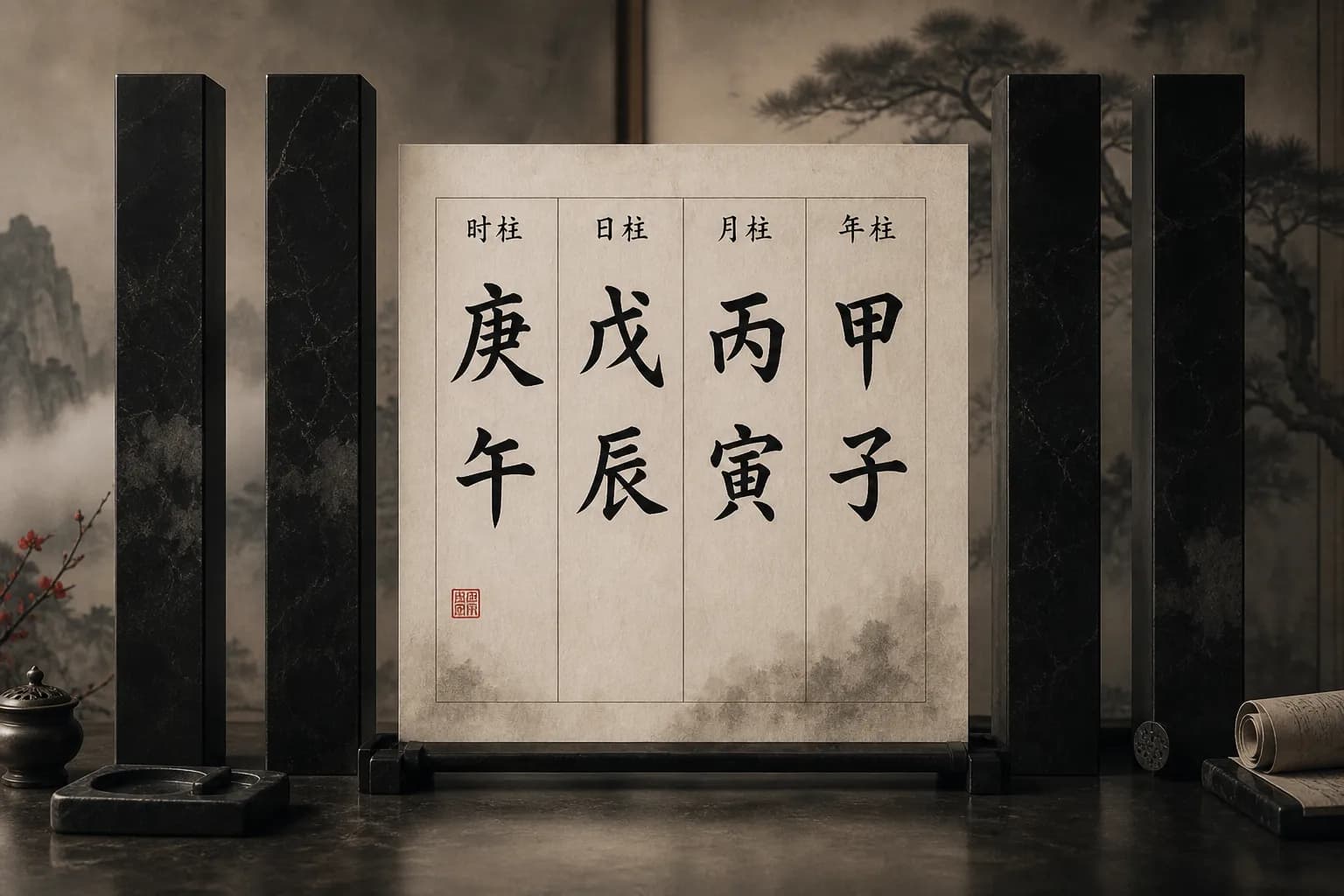
Bazi is the most rigorously structured and formalized system in the entire Chinese astrological family. It uses four temporal anchors from the moment of birth — year, month, day, and hour — converted into eight Chinese characters (four "pillars"), then performs a deterministic derivation chain through Five Element interactions, Ten God relationships, pattern classification, Luck Pillars, Annual Timing, and more.
Bazi's reasoning chain is layered: **Birth Time → Four Pillars → Month Command (月令) → Stem/Branch Strength → Pattern (格局) → Useful Gods (用神) → Ten Gods (十神) → Luck Pillars (大运) → Annual Timing (流年) → Interpretation.** Each layer depends on the output of the one before it. Get the first layer wrong, and everything downstream drifts.
There's a meaningful school-level divergence to note here. The **Pattern School** (represented by *Zi Ping Zhen Quan*) prioritizes the Month Command, examining the Ten Gods revealed in the month-branch to establish the chart's pattern — the success or failure of which determines the chart's overall quality. The **Strength School** (represented by *Di Tian Sui Chan Wei*) first assesses the Day Master's strength, then selects Useful Gods through strengthening or weakening. These aren't mutually exclusive — pattern analysis itself involves strength assessment — but the choice of analytical focus *can* lead to different conclusions for the same chart. **My own inclination is pattern-first**, because the Month Command, as the globally dominant force in any chart, logically deserves priority structural analysis. That doesn't mean strength assessment is unimportant — the success or failure of a pattern is itself built on the balance of Five Element forces.
Bazi's barrier to entry is not low. To read a chart, you need at minimum: Heavenly Stems and Earthly Branches fundamentals, Five Element generation and overcoming, the Ten Gods system, pattern types, and Luck Pillar calculation. But the analytical depth it offers is correspondingly impressive — from static structure to dynamic timelines, from personality tendencies to life-stage analysis, the coverage is broad.
Zi Wei Dou Shu (紫微斗数): The Natal Chart System Built Around Stars
Zi Wei Dou Shu and Bazi are frequently compared, but their underlying logic is quite different. Bazi uses the Five Element generation-overcoming cycle of Stems and Branches as its reasoning engine; Zi Wei Dou Shu uses a **pre-configured star system** — over a hundred stars (major stars, auxiliary stars, malefic stars, transformation stars) arranged across twelve palaces according to the birth time, then interpreted through star combinations and the Four Transformations (Hua Lu, Hua Quan, Hua Ke, Hua Ji).
Zi Wei Dou Shu's palace system is far more granular than Bazi's: the Life Palace, Siblings Palace, Spouse Palace, Children Palace, Wealth Palace, Health Palace, Travel Palace, Friends Palace, Career Palace, Property Palace, Mental Palace, Parents Palace — twelve palaces corresponding to twelve life domains. The combination of stars and the flying transformations within and between palaces creates an intricate network.
Compared with Bazi, Zi Wei Dou Shu is somewhat weaker in "deterministic rule clarity" — the interpretation of star combinations relies more heavily on experiential assignment of meaning, whereas Bazi's Five Element interactions are purely logical. But Zi Wei Dou Shu is **stronger in life-domain granularity**: the twelve-palace structure makes its positioning more intuitive than Bazi's for specific applications like career analysis, relationship assessment, and financial outlook.
The "which is more accurate" debate between Bazi and Zi Wei Dou Shu never stops in practice circles. **The more honest take: they're two different parsers running on the same underlying code, each with its own strengths and blind spots.** Bazi's structural analysis is more rigorous; Zi Wei Dou Shu's domain coverage is more granular. Analyzing the same person with both systems yields different *types* of information — that's not contradiction, it's complementarity.
Liu Yao / Da Liu Ren: Question-Specific Divination Systems
Liu Yao and Da Liu Ren differ fundamentally in functional orientation from the two systems above. Bazi and Zi Wei Dou Shu are **natal analysis** — using the birth time to establish a person's "factory configuration." Liu Yao and Da Liu Ren are **event divination** — targeting a specific question, casting a hexagram at a specific time, and reading the event's trajectory.
Liu Yao is built on the framework of the sixty-four hexagrams from the *I Ching* (Book of Changes). It uses six line positions (yin lines and yang lines) to construct a hexagram, then combines Heavenly Stems, Earthly Branches, and the Six Relatives (Parents, Siblings, Children, Wealth, Officer) to interpret the fortune and development path of a specific event. The core of Liu Yao is the **Useful Line** (用神) — finding, among the six line positions, the one that corresponds to the question, and assessing its strength and change.
Da Liu Ren is an older divination system that constructs a "lesson" (課) from Stems and Branches, then derives conclusions through the Four Lessons and Three Transmissions (四課三传). Its formalization level is high, but its learning curve is steep, and far fewer people use it today compared with Liu Yao and Bazi.
The distinction between divination systems and natal systems lies in the choice of temporal anchor: natal systems anchor to the **moment of birth** (who are you?), divination systems anchor to the **moment of casting** (how will this event unfold?). They answer fundamentally different types of questions — there's no "which is more accurate" because they don't compete on the same axis.
Tai Yi Shen Shu / Qi Men Dun Jia: Macro Spatiotemporal Models
Tai Yi Shen Shu and Qi Men Dun Jia sit at the highest tier of the Chinese metaphysical hierarchy — they don't analyze individual fate, but rather **macro spatiotemporal patterns**: national fortune, military strategy, timing of major events. Tai Yi Shen Shu focuses on the influence of celestial movements on worldly affairs; Qi Men Dun Jia constructs a comprehensive model integrating time, space, and human agency (Heavenly Plate, Earthly Plate, Human Plate, Spirit Plate).
These two systems see relatively little practical application in the modern era and are studied more as important theoretical components of the broader tradition. But their existence demonstrates the design ambition of the Chinese metaphysical framework: from individual destiny to national fortune, from specific events to macro space-time — an attempt to build a universal derivation system.
Date Selection / Feng Shui: Applied Operations in Time and Space
Date selection (choosing auspicious dates) and Feng Shui (spatial environment analysis) form the application layer of the metaphysical system. Date selection uses Stems, Branches, and spirit-deity (神煞) systems to evaluate whether a given time point is suitable or unsuitable for specific activities. Feng Shui uses compass directions, landform features, and Five Element interactions to assess the energy configuration of a space.
These applied disciplines don't generate new theory — they invoke the analytical frameworks established by the systems above. A date selection specialist needs to understand Stems, Branches, spirit-deity systems, and basic Bazi; a Feng Shui practitioner needs to understand directional Elements, the Twenty-Four Mountains, and the fundamentals of yin and yang dwellings.
The Relationships Between These Systems: Not Parallel — Nested
Listing the five traditions side by side makes it easy to mistake them for parallel options — pick whichever you like and go. But the actual relationship is nested:
Heavenly Stems + Earthly Branches + Yin-Yang + Five Elements (shared code) · ├── Natal Analysis Layer · │ ├── Four Pillars Bazi (structure-centered, month-command priority) · │ └── Zi Wei Dou Shu (star-centered, twelve-palace analysis) · ├── Event Divination Layer · │ ├── Liu Yao (based on I Ching hexagrams) · │ └── Da Liu Ren (based on lesson-transmission derivation) · ├── Macro Spatiotemporal Layer · │ ├── Tai Yi Shen Shu · │ └── Qi Men Dun Jia · └── Applied Operations Layer · ├── Date Selection · └── Feng Shui
The underlying Stems, Branches, and Five Elements are the shared "language" every system depends on. Learning Zi Wei Dou Shu doesn't exempt you from understanding hidden Branch Stems; casting Liu Yao hexagrams doesn't let you skip Five Element interactions.
**Each layer addresses a different type of question.** Want to know "who am I?" → Natal Analysis Layer. "How will this event unfold?" → Event Divination Layer. "What's the national outlook?" → Macro Spatiotemporal Layer. "Which day should I move?" → Applied Operations Layer. Mixing systems isn't the problem — knowing *which layer to use for which question* is the practitioner's基本功.
Chinese Astrology vs. Western Astrology: Two Different Encoding Philosophies
One last question that comes up frequently: how does Chinese astrology relate to Western astrology (modern astrological practice)?
They address the same broad questions — the relationship between people and time, innate tendencies versus life paths — but their encoding philosophies are completely different. Western astrology takes planetary positions on the celestial sphere as input, building its interpretive framework through signs, houses, and aspects. Chinese astrology takes the Stem-Branch timekeeping system as input, building its framework through Five Element interactions and Ten God relationships.
Neither is superior. If you analyze the same person using both a Western natal chart and a Chinese Bazi chart, you'll get **different types of information**, not two translations of the same data. That's not redundancy — it's the overlay of distinct perspectives.
But one thing needs to be said honestly: **combining conclusions across systems is a dangerous operation.** If the Western chart says Saturn return is creating pressure this year and the Bazi chart says this Luck Pillar is dominated by an unfavorable element — these signals might *feel* consistent, but they arise from completely different reasoning logics. Treating them as mutual confirmation is a cognitive trap more likely to produce errors than single-system analysis.
Bottom Line
Chinese astrology is a family of systems that share a common language — Heavenly Stems, Earthly Branches, and the Five Elements — but unfold across entirely different dimensions. The twelve zodiac animals are the shallowest cultural entry point. Beneath them lies a layered analytical framework: natal analysis, event divination, macro spatiotemporal modeling, and applied operations — each with its own domain. Understanding this map is more useful than memorizing any single interpretation formula. It tells you which tool to reach for when — instead of throwing every question at "what animal are you."