
Zi Wei Dou Shu vs BaZi: Two Chinese Systems, Two Different Questions
July 19, 2026 · Last verified: 2026-07-19
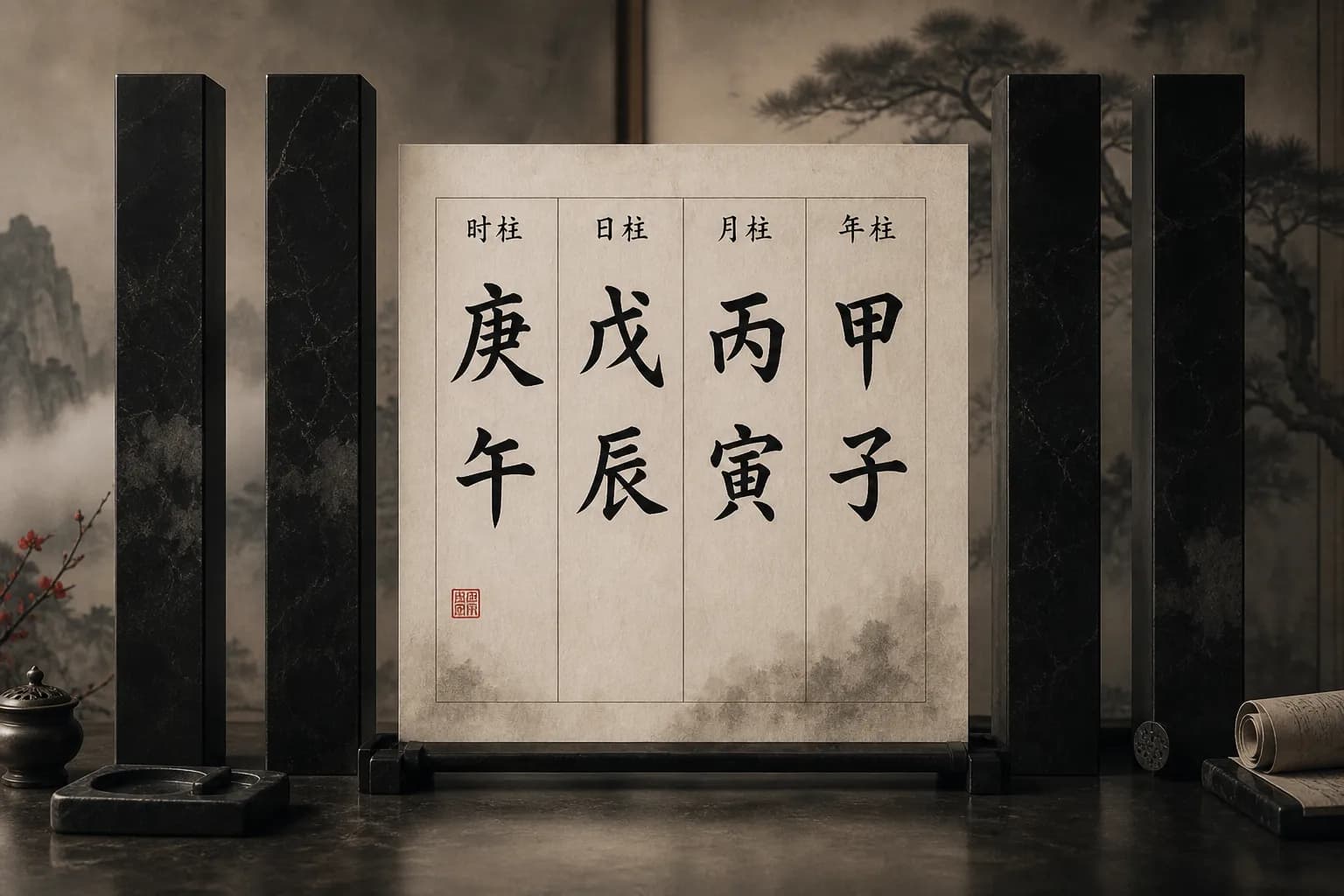
BaZi and Zi Wei Dou Shu both begin with your birth date and time — then they build two very different maps. BaZi, the Four Pillars of Destiny, condenses your birth moment into eight characters and reads the Five Elements, Ten Gods, and ten-year Luck Pillars: it is strongest on structure, timing, and compatibility. Zi Wei Dou Shu places more than a hundred stars across twelve life palaces — Self, Spouse, Career, Wealth, and more — and is strongest on detailed, area-by-area narrative. This page compares the two systems honestly: what each one actually reads, where each is stronger, and the same birth data cast in both charts so you can see the difference for yourself. Neither chart decides your future; each is a lens, and choosing the right lens is the point.
The short answer
BaZi reads elemental structure and timing through the Five Elements, Ten Gods, and ten-year Luck Pillars — condensing your birth moment into eight characters that describe how energy moves around your Day Master. Zi Wei Dou Shu places more than a hundred stars across twelve life palaces — Self, Spouse, Career, Wealth, and more — to produce detailed, area-by-area narrative. One system answers structural rhythm; the other answers what each life domain looks like. Neither is a verdict on your future; each is a lens built for a different kind of question.
How each system builds your chart
Both systems start from birth year, month, day, and hour. BaZi converts them into four pairs of Heavenly Stems and Earthly Branches using the solar-term calendar — the same backbone that drives Chinese festivals and agricultural timing. Month pillars follow solar terms, not lunar month numbers; hour pillars follow two-hour watch periods corrected to true solar time at your birthplace.
Zi Wei Dou Shu uses the lunar date and birth hour to place stars into twelve palaces. The Life palace anchors the chart; major stars such as Zi Wei, Tian Fu, and Wu Qu distribute across palaces according to established placement rules. Auxiliary stars, transformations (Si Hua), and decade limits (Da Xian) add layers of detail.
Why do the two charts look so different at the same birth moment? The calendars differ — solar-term pillars versus lunar placement — and the symbolic vocabulary differs. BaZi reads time as elemental structure; Zi Wei reads life as twelve domains illuminated by star combinations. That difference is normal, not a contradiction.
What each system reads better
Character structure and elemental balance: BaZi. Your Day Master, Ten Gods distribution, and seasonal strength answer how you tend to handle resources, expression, pressure, and peers. For the Ten Gods vocabulary, see /guides/shishen.
Domain-specific event granularity: Zi Wei. The Spouse palace and its stars describe relationship patterns over time; the Wealth and Career palaces map material and professional themes with more palace-level specificity. For palace concepts, see the Zi Wei Dou Shu guide at /guides/ziwei and the Self (Life) palace at /guides/ziwei/palaces/life.
Timing cycles: both, by different tracks. BaZi uses ten-year Luck Pillars (Da Yun) and annual pillars; see /guides/dayun. Zi Wei uses decade limits (Da Xian) and annual palace activations.
Compatibility: BaZi handles two-chart matching directly — comparing Day Masters, elements, and branch interactions. Try the BaZi compatibility tool at /atlas/relationship when relationship is your question.
For another classical pairing in the same tradition, see Qi Men Dun Jia vs BaZi at /guides/compare/qi-men-dun-jia-vs-bazi.
Same birth data, two charts
Demonstration case — fictional example for illustration only.
Take a birth on May 8, 1988, 9:42 a.m. local time in Chengdu, China (true solar time applied). The same moment yields two different maps.
BaZi reading (three sentences): The Day Master is Yang Earth born in late spring — the season still favors Wood output, framing a chart that often expresses through creation, teaching, or visible work. Officer and wealth stars appear in the month and hour context, suggesting a life rhythm where responsibility and resource-building recur as themes. Current Luck Pillar shifts toward Metal — a decade where structure, boundaries, and refinement may come to the foreground.
Zi Wei Dou Shu reading (three sentences): The Life palace hosts Tian Ji with Zi Wei in the Career palace, framing someone who thinks in systems and may pursue work that rewards strategy and communication. The Spouse palace carries Ju Men — relationship narrative often emphasizes dialogue, adjustment, and learning through friction rather than a single perfect-match label. The current decade limit activates the Wealth palace, where the same career theme may read as income structure and financial decision points rather than elemental timing.
Same person, same birth moment — one chart speaks in elements and cycles; the other in palaces and stars. The themes may rhyme; the language does not.
Which one should you start with?
If you want to grasp your chart's structure quickly — Day Master, element balance, Luck Pillar rhythm — start with BaZi. The free BaZi calculator at /atlas/bazi-calculate includes true solar time, Ten Gods, Symbolic Stars, and Luck Pillars.
If your question is domain-specific — what does my Career palace suggest, or how do stars in the Spouse palace play out over time — start with Zi Wei Dou Shu at /atlas/ziwei-doushu.
If you only want a yes-or-no answer to a specific decision without understanding the map, neither system is the right first step. Clarify the question first; then pick the lens.
Can you use both together?
Experienced readers often cross-check: use one system as the primary lens and the other to validate or deepen a theme. When both point at the same motif — structure versus freedom, visibility versus security — treat the overlap as a stronger signal. When they emphasize different things, treat that as two questions worth asking, not as one system winning.
Avoid answer-shopping: casting both until you hear what you want is not reading; it is shopping for comfort.
Whichever system you start with, treat the chart as a reference map. BaZi and Zi Wei Dou Shu describe patterns and timing within their own traditions; what you do with that picture is your call.
FAQ
Is Zi Wei Dou Shu more accurate than BaZi?
Neither system is more "accurate" — they read different layers of the same birth data. BaZi reads elemental structure and timing cycles; Zi Wei Dou Shu reads twelve life domains through star placements. Within each tradition, the result depends far more on a correct birth time (and, for BaZi, true solar time correction) than on the choice of system. The useful question is not "which is right" but "which one is built to answer my kind of question."
Do BaZi and Zi Wei Dou Shu use the same birth data?
Both start from your birth year, month, day, and hour. BaZi converts them into four pairs of Heavenly Stems and Earthly Branches using the solar-term calendar; Zi Wei Dou Shu uses the lunar date and birth hour to place stars into twelve palaces. Because the calendars differ, the same birth moment produces two very different-looking charts — which is normal, not a contradiction.
Which system is better for relationship questions?
BaZi handles compatibility directly — comparing two charts' Day Masters, elements, and branch interactions. Zi Wei Dou Shu describes relationship patterns through the Spouse palace and its stars. Many readers use BaZi for the "how do we interact" layer and Zi Wei for the "what does this life area look like over time" layer. You can try both on FateForge: the BaZi compatibility tool and the Zi Wei chart are both free.
Can BaZi and Zi Wei Dou Shu contradict each other?
They can emphasize different things, because they are different instruments — a thermometer and a clock do not contradict each other either. When experienced readers cross-check, the two systems usually converge on the same broad themes by different routes. Treat both as reference maps, not verdicts: a reading is input for your judgment, not a replacement for it.
Where can I cast both charts for free?
FateForge offers both: the free BaZi calculator (true solar time, Ten Gods, Symbolic Stars, and Luck Pillars included) and the free Zi Wei Dou Shu calculator (12 palaces with major stars and transformations). No signup is needed for either chart.
Try both charts free
Generate your Four Pillars at /atlas/bazi-calculate — free BaZi calculator with true solar time, Ten Gods, Symbolic Stars, and Luck Pillars included. Open your Zi Wei chart at /atlas/ziwei-doushu — twelve palaces with major stars and transformations. No signup required for either.