FFFateForge

Destiny

  • BBaZi Chart
  • DDaily Fortune
  • BBaZi Marriage
  • RRelationship Compatibility
  • RRelationship Network
  • ZZi Wei Chart

Divination

  • DDaily Decision
  • DDeep Consultation
  • TTarot
  • TTarot Reference
  • TTiming & Direction
  • HHuman Affairs

World Traditions

  • NNatal Chart
  • NNumerology
  • VVedic Astrology
  • NNorse Runes

Tools

  • AAI Almanac
  • LLife K-Line
  • HHistory
Unlock all features
GGuestSigned out
FF
  • Home
  • Analysis
  • Blog
  • Pricing
  • Account
Start a reading
FFFateForge

Find the pattern. Forge your path.

[email protected]

BaZi

  • BaZi Chart
  • Daily Fortune
  • BaZi Marriage
  • Relationship Compatibility
  • Relationship Network

Zi Wei

  • Zi Wei Chart

Zhou Yi

  • Daily Decision
  • Deep Consultation

Tarot

  • Tarot Reading
  • Tarot Card Meanings
  • Timing & Direction
  • Human Affairs

Guides

  • Read Five Elements
  • Heavenly Stems Basics
  • Read Earthly Branches
  • Build Sixty Jiazi
  • Read Nayin
  • Read Ten Gods
  • Use Shen Sha
  • Read Bazi Patterns
  • Read Branch Interactions
  • Read Da Yun
  • Find the Start Age
  • Check True Solar Time
  • Handle Zi Hour
  • Start With Hexagrams
  • Set Liuyao Najia
  • Read Six Relations
  • Place Shi and Ying
  • Assign Six Spirits
  • History of Chinese Metaphysics

Tools

  • Western Astrology
  • Numerology
  • Vedic Astrology
  • Norse Runes
  • AI Almanac
  • Life K-Line
  • History
  • Blog

Company

  • Privacy Policy
  • Terms of Service

© 2026 FateForge. All rights reserved.

简体中文|English|繁體中文|日本語

How to Build the Sixty Jiazi Cycle

See how stems and branches form sixty time coordinates and how they support Four Pillars charts.

Overview

The sixty Jiazi (六十甲子) are sixty sequential groups formed by the Heavenly Stems (天干) and Earthly Branches (地支) according to specific rules. They constitute the most fundamental time cycle system in the traditional Chinese calendar. From Jiazi (甲子) to Guihai (癸亥), a complete cycle spans sixty years. The sixty Jiazi (六十甲子) are widely applied across all dimensions of time—years, months, days, and hours—and form the core foundation of traditional Chinese calendar systems and destiny studies. As early as the oracle bone inscriptions of the Yin-Shang period, records of Stem-Branch day-keeping already appeared, proving that this system has a history of at least three thousand years.

Combination Rules

There are ten Heavenly Stems (天干) (Jia 甲, Yi 乙, Bing 丙, Ding 丁, Wu 戊, Ji 己, Geng 庚, Xin 辛, Ren 壬, Gui 癸) and twelve Earthly Branches (地支) (Zi 子, Chou 丑, Yin 寅, Mao 卯, Chen 辰, Si 巳, Wu 午, Wei 未, Shen 申, You 酉, Xu 戌, Hai 亥). In combination, they are paired in sequence: Jiazi (甲子), Yichou (乙丑), Bingyin (丙寅), Dingmao (丁卯)… When the ten Stems are exhausted, they restart from Jia (甲); when the twelve Branches are exhausted, they restart from Zi (子). Since the least common multiple of ten and twelve is sixty, after sixty combinations the Stems and Branches simultaneously return to their starting points, completing a full cycle.

Arrangement Logic

The arrangement of the sixty Jiazi (六十甲子) follows the principle of Yang Stems pairing with Yang Branches and Yin Stems pairing with Yin Branches. Specifically, the five Yang Stems Jia (甲), Bing (丙), Wu (戊), Geng (庚), and Ren (壬) pair with the six Yang Branches Zi (子), Yin (寅), Chen (辰), Wu (午), Shen (申), and Xu (戌); the five Yin Stems Yi (乙), Ding (丁), Ji (己), Xin (辛), and Gui (癸) pair with the six Yin Branches Chou (丑), Mao (卯), Si (巳), Wei (未), You (酉), and Hai (亥). Each Jiazi (甲子) group possesses unique Yin-Yang and Five Element (五行) attributes, serving as an important basis for analyzing temporal energy changes. The arrangement of the sixty Jiazi (六十甲子) is not merely a mechanical combination, but embodies profound astronomical, calendrical, and philosophical significance.

Year, Month, Day, and Hour Recording

The sixty Jiazi (六十甲子) can be used to record different time scales:

Year recording: Every sixty years completes one Jiazi (甲子) cycle, called one Jiazi (一甲子). Historically, years were often recorded using the Jiazi (甲子) system, such as \"Jiazi year\" (甲子年) or \"Wuxu year\" (戊戌年).

Month recording: Every five years, or sixty months, completes one Jiazi (甲子) cycle. Month Stems and Branches are calculated based on the year Stem according to specific rules.

Day recording: Every sixty days completes one Jiazi (甲子) day cycle. The Stem-Branch day recording system is the longest continuously used day-keeping system in Chinese history, in use from the Spring and Autumn period to the present day.

Hour recording: Every five days, or sixty time periods, completes one Jiazi (甲子) hour cycle.

The Concept of Xuankong (旬空)

The sixty Jiazi (六十甲子) can be divided into six Xun (旬), each containing ten days: the Jiazi Xun (甲子旬, Jiazi to Guiyou), the Jiaxu Xun (甲戌旬, Jiaxu to Guiwei), the Jiashen Xun (甲申旬, Jiashen to Guisi), the Jiawu Xun (甲午旬, Jiawu to Guimao), the Jiachen Xun (甲辰旬, Jiachen to Guichou), and the Jiayin Xun (甲寅旬, Jiayin to Guihai). In each Xun (旬), there are always two Earthly Branches (地支) without a matching Heavenly Stem (天干), known as Xuankong (旬空, empty within the Xun). For example, in the Jiazi Xun (甲子旬), Xu (戌) and Hai (亥) are empty; in the Jiaxu Xun (甲戌旬), Shen (申) and You (酉) are empty. In destiny analysis, Xuankong (旬空) indicates the temporary absence or insufficiency of certain forces, and also symbolizes emptiness, change, and uncertainty.

Applications

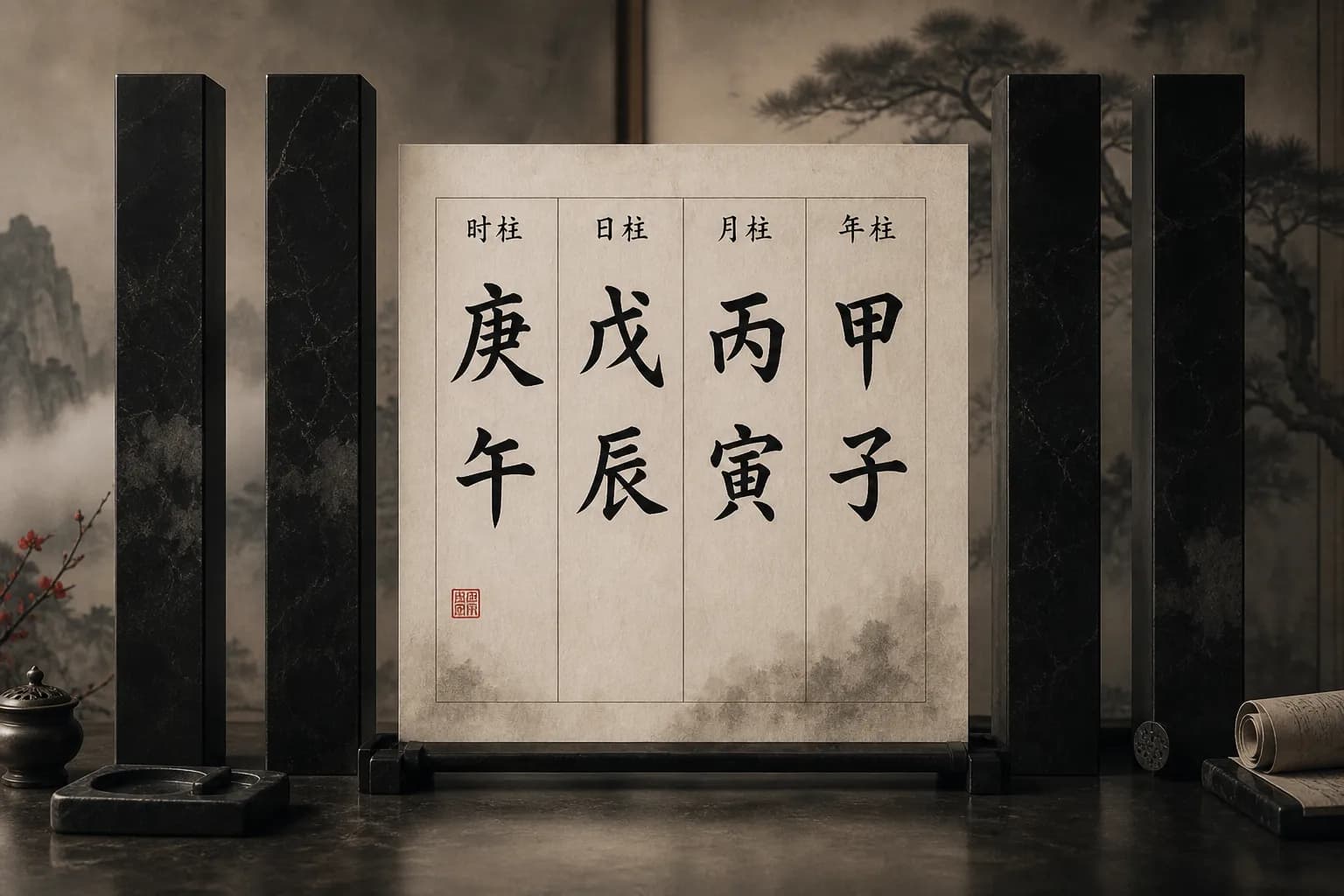
The sixty Jiazi (六十甲子) are the core foundation of Bazi (八字) destiny analysis. By recording the Stems and Branches corresponding to a person's birth year, month, day, and hour, the Four Pillars (四柱) and Eight Characters (八字) can be arranged, enabling analysis of the destiny structure, Five Element (五行) distribution, Ten God (十神) configuration, and fortune trajectory. The sixty Jiazi (六十甲子) are also an important reference for traditional date selection, feng shui (风水) arrangement, and agricultural planning, holding an irreplaceable position in traditional Chinese culture.

Related topics

  • Heavenly Stems Basics: What Jia Through Gui Represent
  • How to Read Earthly Branches: Direction, Season, and Hidden Stems
  • How to Read Nayin: Another Layer of the Sixty Jiazi