
How to Read Nayin: Another Layer of the Sixty Jiazi
Use Nayin as symbolic texture and time quality, while keeping it distinct from primary Five Elements.
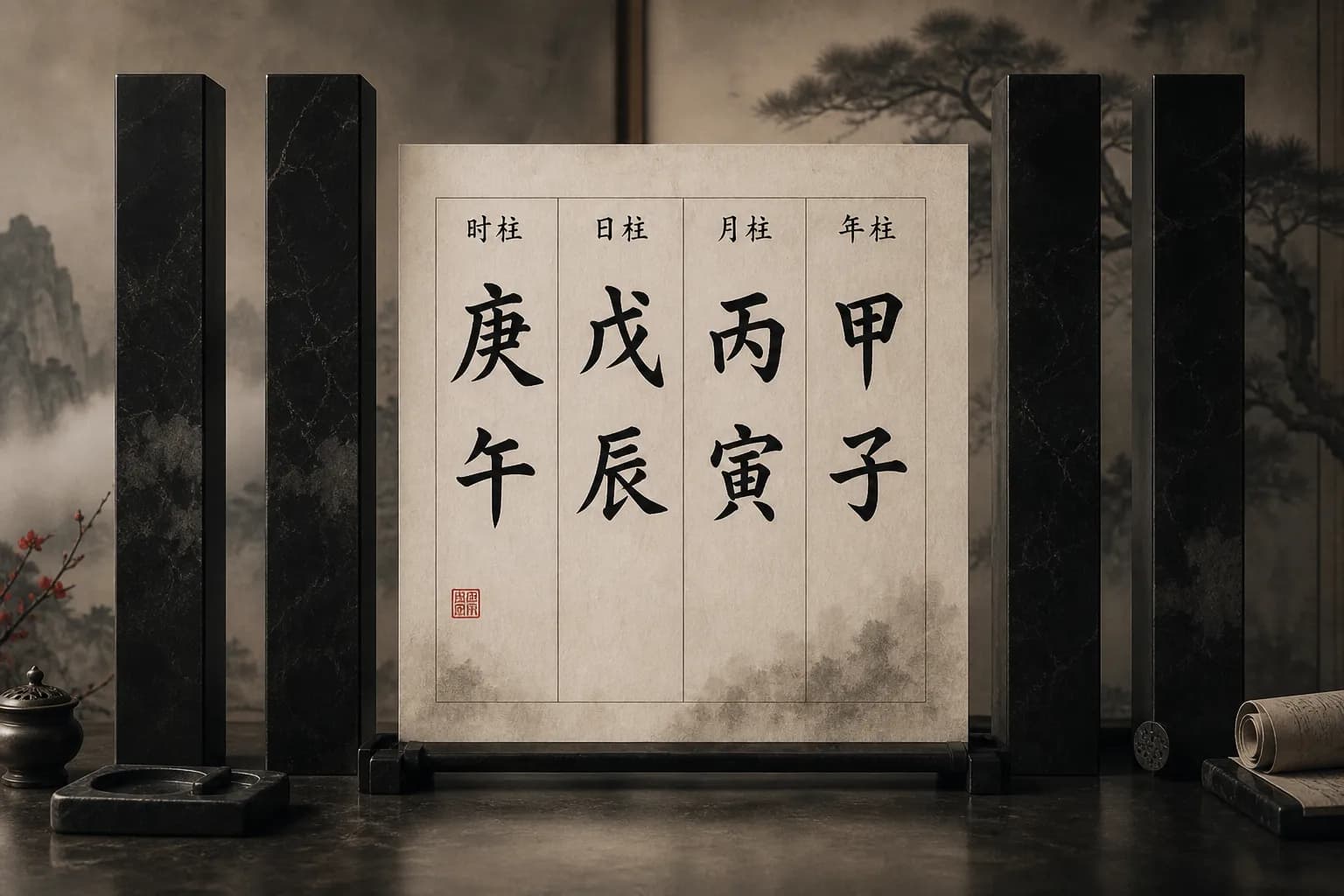
The Concept of Nayin (纳音)
Nayin Five Elements (纳音五行) is another unique Five Element (五行) classification method within the sixty Jiazi (六十甲子) system. It groups the sixty Stem-Branch pairs into thirty Nayin (纳音) pairs according to the laws of ancient musical pitch, with each pair corresponding to a Five Element (五行) attribute. Nayin (纳音) theory originates from the deep integration of ancient musical pitch studies (the five notes and twelve pitches, 五音十二律) and Five Element (五行) thought, providing a more detailed and deeper dimension of Five Element (五行) judgment for destiny analysis. The name \"Nayin\" (纳音, receiving the note) means incorporating the notes of the Stems and Branches into the Five Elements (五行), reflecting the ancient Chinese philosophical idea of \"the unity of heaven and humanity.\"
Overview of the Thirty Nayin Pairs (三十对纳音概览)
Every two groups of Stems and Branches in the sixty Jiazi (六十甲子) share one Nayin (纳音) name, forming thirty pairs of Nayin (纳音). Nayin names mostly use specific substances from the natural world, such as \"Metal in the Sea\" (海中金), \"Fire in the Furnace\" (炉中火), and \"Great Forest Wood\" (大林木), vividly and intuitively expressing the Five Element (五行) characteristics of that group of Stems and Branches. This method of using objects to illustrate principles makes the abstract Five Element (五行) concepts concrete and perceptible, facilitating understanding and memory.
Six Types of Metal (金类六种)
Metal (金) category Nayin includes: \"Metal in the Sea\" (海中金, Jiazi 甲子 and Yichou 乙丑), symbolizing metal hidden deep in the sea, its edge not yet revealed; \"Sword-Edge Metal\" (剑锋金, Renshen 壬申 and Guiyou 癸酉), symbolizing the sharpness of a blade, incomparably keen; \"White Wax Metal\" (白蜡金, Gengchen 庚辰 and Xinsi 辛巳), symbolizing the luster of white wax, soft outside but firm inside; \"Metal in the Sand\" (沙中金, Jiawu 甲午 and Yiwei 乙未), symbolizing gold to be panned from sand, needing refinement to reveal its preciousness; \"Gold Foil Metal\" (金箔金, Renyin 壬寅 and Guimao 癸卯), symbolizing the thinness of gold foil, outwardly magnificent; and \"Hairpin and Ornament Metal\" (钗钏金, Gengxu 庚戌 and Xinhai 辛亥), symbolizing the metal of jewelry, exquisite and delicate.
Six Types of Wood (木类六种)
Wood (木) category Nayin includes: \"Great Forest Wood\" (大林木, Wuchen 戊辰 and Jisi 己巳), symbolizing the great trees of a forest, lush and upright; \"Willow Wood\" (杨柳木, Renwu 壬午 and Guiwei 癸未), symbolizing the suppleness of willows, swaying in the wind; \"Pine and Cypress Wood\" (松柏木, Gengyin 庚寅 and Xinmao 辛卯), symbolizing the steadfastness of pine and cypress, evergreen in all seasons; \"Level Ground Wood\" (平地木, Wuxu 戊戌 and Jihai 己亥), symbolizing the trees on flat ground, with solid roots; \"Mulberry and Oak Wood\" (桑柘木, Renzi 壬子 and Guichou 癸丑), symbolizing the practical and simple wood of mulberry and oak; and \"Pomegranate Wood\" (石榴木, Gengshen 庚申 and Xinyou 辛酉), symbolizing the pomegranate tree laden with fruit.
Six Types of Water (水类六种)
Water (水) category Nayin includes: \"Stream Water\" (涧下水, Bingzi 丙子 and Dingchou 丁丑), symbolizing the clear stream in a mountain valley, transparent to the bottom; \"Water in the Spring\" (泉中水, Jiashen 甲申 and Yiyou 乙酉), symbolizing the water of a spring, flowing continuously; \"Flowing Water\" (长流水, Renchen 壬辰 and Guisi 癸巳), symbolizing the long flow of rivers, rushing ceaselessly; \"Heavenly River Water\" (天河水, Bingwu 丙午 and Dingwei 丁未), symbolizing the water of the Milky Way, lofty and mysterious; \"Great Stream Water\" (大溪水, Jiayin 甲寅 and Yimao 乙卯), symbolizing the water of streams converging into momentum; and \"Sea Water\" (大海水, Renxu 壬戌 and Guihai 癸亥), symbolizing the vastness of the sea, embracing all things.
Six Types of Fire (火类六种)
Fire (火) category Nayin includes: \"Fire in the Furnace\" (炉中火, Bingyin 丙寅 and Dingmao 丁卯), symbolizing the fire in a furnace, warm and enduring; \"Fire on the Mountain\" (山头火, Jiaxu 甲戌 and Yihai 乙亥), symbolizing the fire on a mountain, lofty and bright; \"Thunderbolt Fire\" (霹雳火, Wuzi 戊子和 Jichou 己丑), symbolizing the fire of thunder and lightning, sudden and fierce; \"Fire under the Mountain\" (山下火, Bingshen 丙申 and Dingyou 丁酉), symbolizing the fire beneath a mountain, its light restrained; \"Lamp-Covering Fire\" (覆灯火, Jiachen 甲辰 and Yisi 乙巳), symbolizing the fire of a lamp, illuminating the darkness; and \"Fire in the Sky\" (天上火, Wuwu 戊午 and Jiwei 己未), symbolizing the fire of the sun, shining upon all things.
Six Types of Earth (土类六种)
Earth (土) category Nayin includes: \"Earth by the Roadside\" (路旁土, Gengwu 庚午 and Xinwei 辛未), symbolizing the earth by the roadside, traveled by people coming and going; \"Earth on the City Wall\" (城头土, Wuyin 戊寅 and Jimao 己卯), symbolizing the earth of a city wall, firm and protective; \"Earth on the Roof\" (屋上土, Bingxu 丙戌 and Dinghai 丁亥), symbolizing the earth on a roof, sheltering from wind and rain; \"Earth on the Wall\" (壁上土, Gengzi 庚子 and Xinchou 辛丑), symbolizing the earth on a wall, protecting what lies within; \"Earth at the Great Post Station\" (大驿土, Wushen 戊申 and Jiyou 己酉), symbolizing the earth of a post station, facilitating transportation; and \"Earth in the Sand\" (沙中土, Bingchen 丙辰 and Dingsi 丁巳), symbolizing the earth in sand, fine and loose.
Applications
Nayin Five Elements (纳音五行) can be used in destiny analysis as a supplementary reference to the primary Five Elements (正五行), for judging the deep structure and energy levels of the Five Elements (五行) within the destiny chart. Nayin (纳音) is also used in traditional date selection and feng shui (风水) theory, helping to more precisely grasp the characteristics of temporal energy. When analyzing a destiny chart, combining Nayin Five Elements (纳音五行) with the primary Five Elements (正五行) yields more comprehensive and in-depth judgment results.