FFFateForge

Destiny

  • BBaZi Chart
  • DDaily Fortune
  • BBaZi Marriage
  • RRelationship Compatibility
  • RRelationship Network
  • ZZi Wei Chart

Divination

  • DDaily Decision
  • DDeep Consultation
  • TTarot
  • TTarot Reference
  • TTiming & Direction
  • HHuman Affairs

World Traditions

  • NNatal Chart
  • NNumerology
  • VVedic Astrology
  • NNorse Runes

Tools

  • AAI Almanac
  • LLife K-Line
  • HHistory
Unlock all features
GGuestSigned out
FF
  • Home
  • Analysis
  • Blog
  • Pricing
  • Account
Start a reading
FFFateForge

Find the pattern. Forge your path.

[email protected]

BaZi

  • BaZi Chart
  • Daily Fortune
  • BaZi Marriage
  • Relationship Compatibility
  • Relationship Network

Zi Wei

  • Zi Wei Chart

Zhou Yi

  • Daily Decision
  • Deep Consultation

Tarot

  • Tarot Reading
  • Tarot Card Meanings
  • Timing & Direction
  • Human Affairs

Guides

  • Read Five Elements
  • Heavenly Stems Basics
  • Read Earthly Branches
  • Build Sixty Jiazi
  • Read Nayin
  • Read Ten Gods
  • Use Shen Sha
  • Read Bazi Patterns
  • Read Branch Interactions
  • Read Da Yun
  • Find the Start Age
  • Check True Solar Time
  • Handle Zi Hour
  • Start With Hexagrams
  • Set Liuyao Najia
  • Read Six Relations
  • Place Shi and Ying
  • Assign Six Spirits
  • History of Chinese Metaphysics

Tools

  • Western Astrology
  • Numerology
  • Vedic Astrology
  • Norse Runes
  • AI Almanac
  • Life K-Line
  • History
  • Blog

Company

  • Privacy Policy
  • Terms of Service

© 2026 FateForge. All rights reserved.

简体中文|English|繁體中文|日本語

Heavenly Stems Basics: What Jia Through Gui Represent

Read stems through yin-yang, Five Elements, combination, and their role inside the chart.

Overview

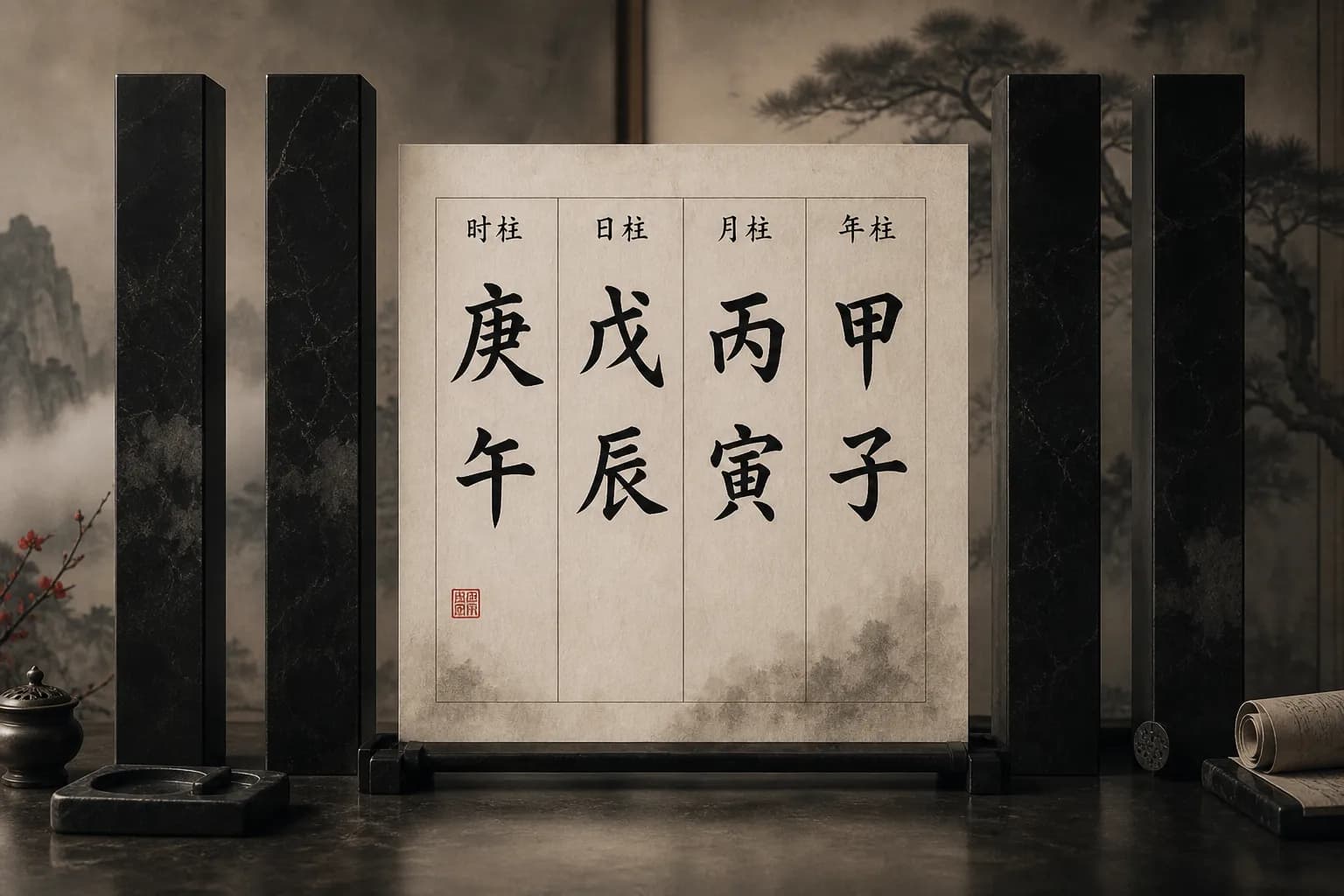
The Heavenly Stems (天干) are ten fundamental symbols used in ancient China to record time, years, months, days, and hours: Jia (甲), Yi (乙), Bing (丙), Ding (丁), Wu (戊), Ji (己), Geng (庚), Xin (辛), Ren (壬), and Gui (癸). The Heavenly Stems (天干) and Earthly Branches (地支) are combined according to specific rules to form the sixty Jiazi (六十甲子) cycle, which is the core foundational element of traditional calendar systems, astronomical observation, and destiny studies. The origin of the Heavenly Stems (天干) system can be traced back to remote antiquity, and through its development across the Xia, Shang, and Zhou dynasties, it became an important component of ancient China's time measurement system.

Yin and Yang of the Heavenly Stems (天干阴阳)

The ten Heavenly Stems (天干) are divided into Yin and Yang categories according to odd and even positions, reflecting the fundamental concept of Yin-Yang balance in ancient Chinese philosophy:

Yang Stems: Jia (甲), Bing (丙), Wu (戊), Geng (庚), Ren (壬) Yin Stems: Yi (乙), Ding (丁), Ji (己), Xin (辛), Gui (癸)

Yang Stems symbolize strength, activity, outwardness, and expansion—forces that are positive, proactive, and pioneering. Yin Stems symbolize gentleness, introspection, stillness, and contraction—forces that are reserved, profound, steady, and conservative. In destiny analysis, the Yin-Yang attribute of a Heavenly Stem (天干) affects how it interacts with the Day Master. The effect of Yang Stems is usually direct and obvious, while that of Yin Stems is more indirect and subtle.

Five Elements of the Heavenly Stems (天干五行)

Each of the ten Heavenly Stems (天干) has its own Five Element (五行) attribute, allocated in pairs according to the sequence of Wood, Fire, Earth, Metal, and Water:

Jia (甲) and Yi (乙) belong to Wood (木); Bing (丙) and Ding (丁) belong to Fire (火); Wu (戊) and Ji (己) belong to Earth (土); Geng (庚) and Xin (辛) belong to Metal (金); Ren (壬) and Gui (癸) belong to Water (水).

Among them, Jia (甲), Bing (丙), Wu (戊), Geng (庚), and Ren (壬) are Yang Stems, corresponding to Yang Wood (阳木), Yang Fire (阳火), Yang Earth (阳土), Yang Metal (阳金), and Yang Water (阳水) respectively. Yi (乙), Ding (丁), Ji (己), Xin (辛), and Gui (癸) are Yin Stems, corresponding to Yin Wood (阴木), Yin Fire (阴火), Yin Earth (阴土), Yin Metal (阴金), and Yin Water (阴水) respectively. This dual attribute of Yin-Yang and Five Elements gives the Heavenly Stems (天干) richer symbolic meanings and layers of effect.

Personality of the Ten Heavenly Stems (十天干各自性格)

Jia Wood (甲木) and Yi Wood (乙木) Jia Wood (甲木) is Yang Wood, like a towering tree—upright and ascending, possessing leadership and enterprise. People of Jia Wood (甲木) are usually upright, responsible, and independent, but sometimes overly rigid and lacking flexibility. Yi Wood (乙木) is Yin Wood, like flowers and vines—supple and delicate, skilled at adapting to the environment. People of Yi Wood (乙木) are usually gentle, meticulous, good at coordination, with strong adaptability and aesthetic sensibility.

Bing Fire (丙火) and Ding Fire (丁火) Bing Fire (丙火) is Yang Fire, like the sun shining everywhere—warm and open, with powerful influence and radiance. People of Bing Fire (丙火) are usually generous, positive, and expressive. Ding Fire (丁火) is Yin Fire, like the light of a lamp—delicate and focused, skilled at discerning the essence of things. People of Ding Fire (丁火) are usually thoughtful, observant, and detail-oriented.

Wu Earth (戊土) and Ji Earth (己土) Wu Earth (戊土) is Yang Earth, like a high mountain or thick soil—steady and reliable, with great bearing capacity. People of Wu Earth (戊土) are usually honest, trustworthy, steadfast, and responsible. Ji Earth (己土) is Yin Earth, like garden soil—delicate and inclusive, skilled at harmonizing all sides. People of Ji Earth (己土) are usually thoughtful, caring toward others, patient, and tolerant.

Geng Metal (庚金) and Xin Metal (辛金) Geng Metal (庚金) is Yang Metal, like a sharp sword—resolute and decisive, with the power to transform and execute. People of Geng Metal (庚金) are usually strong-willed, principled, and value integrity. Xin Metal (辛金) is Yin Metal, like jewelry and ornaments—refined and reserved, pursuing perfection. People of Xin Metal (辛金) usually pay attention to appearance, are meticulous, and have high standards of taste.

Ren Water (壬水) and Gui Water (癸水) Ren Water (壬水) is Yang Water, like great rivers and seas—unrestrained and wise, with great creativity and inclusiveness. People of Ren Water (壬水) are usually intelligent, open-minded, strategic, and adaptable. Gui Water (癸水) is Yin Water, like dew and gentle streams—delicate and profound, skilled at permeation and accumulation. People of Gui Water (癸水) are usually meticulous in thought, emotionally rich, and possess strong intuition.

Heavenly Stem Combination and Transformation (天干合化)

There are five groups of combination and transformation relationships among the Heavenly Stems (天干). When a combination successfully transforms, the forces of the two Stems merge and convert into a new Five Element (五行):

Jia (甲) and Ji (己) combine to transform into Earth (土); Yi (乙) and Geng (庚) combine to transform into Metal (金); Bing (丙) and Xin (辛) combine to transform into Water (水); Ding (丁) and Ren (壬) combine to transform into Wood (木); Wu (戊) and Gui (癸) combine to transform into Fire (火).

For a successful transformation, certain conditions must be met, including adjacency and support from the transforming spirit. In destiny analysis, combination and transformation represent the merging and transformation of two forces, usually signifying the union of relationships, the transformation of events, or the emergence of new opportunities.

Applications

In Bazi (八字) destiny analysis, the arrangement and combination of the Heavenly Stems (天干) reflect a person's innate endowments and personality traits. By systematically analyzing the position, strength, generating-controlling-transformation, and combination relationships of the Heavenly Stems (天干) within the destiny chart, one can understand a person's basic character, abilities, interpersonal characteristics, and life direction. Heavenly Stem (天干) analysis is the foundational step in Bazi (八字) destiny analysis and an important entry point for understanding the overall structure of the destiny chart.

Related topics

  • How to Read Earthly Branches: Direction, Season, and Hidden Stems
  • How to Build the Sixty Jiazi Cycle
  • How to Read the Five Elements