How to Read the Five Elements
Use cycles, seasonal strength, and chart context to read the atmosphere of a Bazi chart.
Origins of the Five Elements (五行)
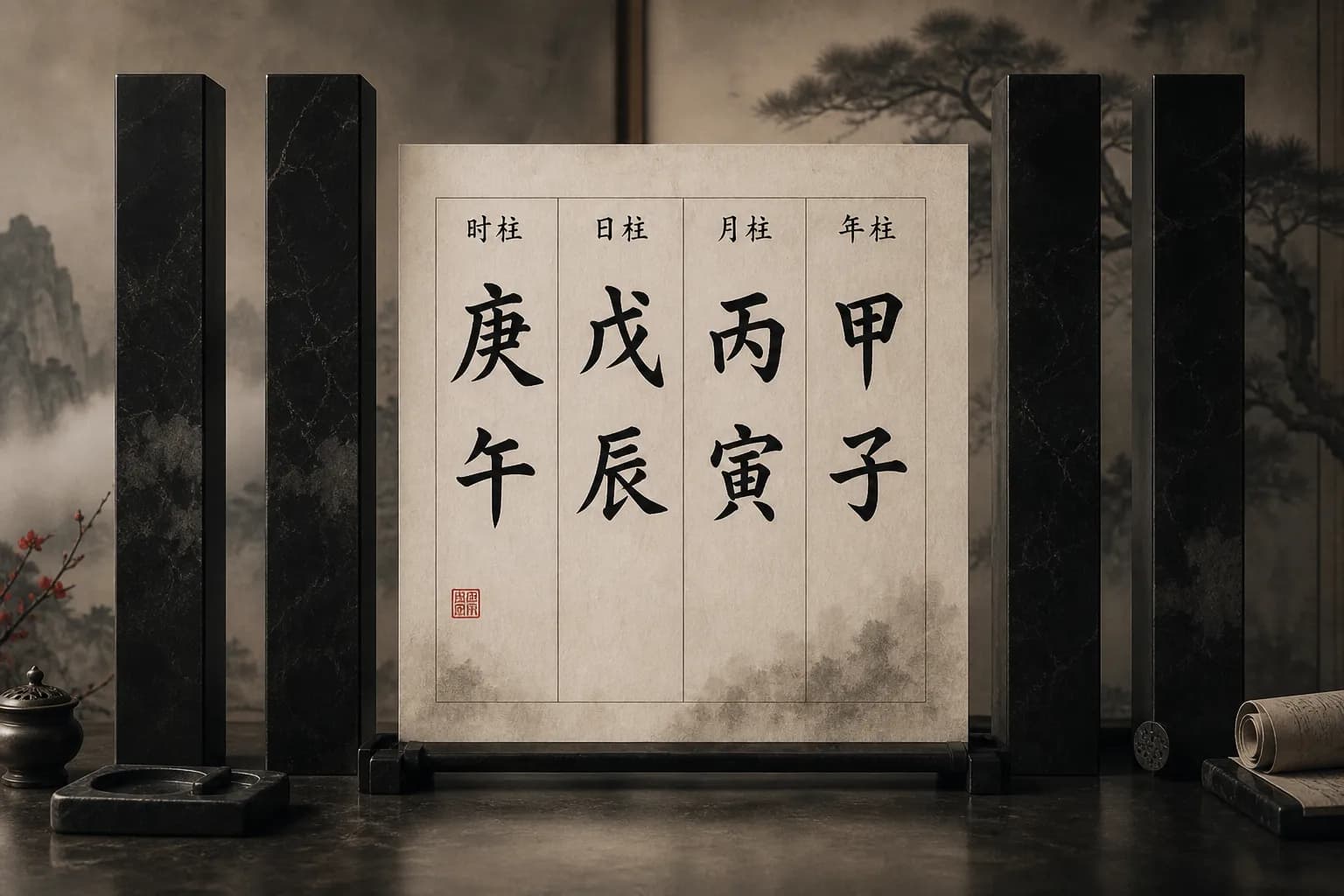
The theory of the Five Elements (五行) is one of the core ideas in ancient Chinese philosophy. Its earliest systematic record appears in the "Great Plan" chapter of the Book of Documents (《尚书·洪范》): \"The Five Elements: first is Water, second is Fire, third is Wood, fourth is Metal, fifth is Earth.\" Through long-term observation of the patterns governing all things in nature, the ancients distilled the fundamental substances of the universe into five categories—Wood, Fire, Earth, Metal, and Water—to explain changes in the natural world, human physiology and pathology, and the rise and fall of human society. The Five Elements (五行) thought was developed and refined through the pre-Qin period's various schools of thought, becoming an important theoretical foundation of traditional Chinese culture and profoundly influencing fields such as traditional Chinese medicine (中医), destiny analysis (命理), astronomy, and agronomy.
Properties of the Five Elements (五行)
Wood (木) Wood (木) is characterized by growth, expansion, and upward movement. In nature it corresponds to trees and plants, symbolizing spring and the east. Wood (木) is both flexible and resilient, able to bend and stretch. In destiny analysis, it governs benevolence, integrity, and enterprise.
Fire (火) Fire (火) is characterized by blazing upward and warmth, representing passion, light, and upward energy. It corresponds to summer and the south, serving to drive development and illuminate surroundings. Fire (火) governs propriety, manifesting in personality as warmth, openness, and positivity.
Earth (土) Earth (土) is characterized by bearing and transformation, representing stability, inclusiveness, and harmony. It corresponds to the final month of each season and the central direction, forming the foundation for the growth of all things. Earth (土) governs trustworthiness, symbolizing honesty, sincerity, and magnanimity, with the capacity to harmonize all directions.
Metal (金) Metal (金) is characterized by sternness and contraction, representing decisiveness, fortitude, and transformation. It corresponds to autumn and the west, possessing the qualities of gathering and restraint. Metal (金) governs righteousness, symbolizing unyielding integrity and principle, as well as decisiveness and change.
Water (水) Water (水) is characterized by moistening downward and coolness, representing wisdom, flow, and downward movement. It corresponds to winter and the north, nourishing all things and permeating everywhere. Water (水) governs wisdom, symbolizing intelligence, adaptability, and resourcefulness.
Generating Cycle (相生)
The generating cycle (相生) refers to how one element promotes the growth of another, forming an endless loop of energy transfer:
Wood (木) generates Fire (火) → Fire (火) generates Earth (土) → Earth (土) generates Metal (金) → Metal (金) generates Water (水) → Water (水) generates Wood (木)
Specifically: wood burns to produce fire, so Wood (木) generates Fire (火); fire leaves ash that returns to the earth, so Fire (火) generates Earth (土); soil contains metallic minerals, so Earth (土) generates Metal (金); metal melts into liquid when heated, so Metal (金) generates Water (水); water nourishes trees so they may grow, so Water (水) generates Wood (木). The generating cycle reflects the harmonious state of mutual dependence and promotion among all things in nature.
Controlling Cycle (相克)
The controlling cycle (相克) refers to how one element restrains the development of another, preventing excessive expansion:
Wood (木) controls Earth (土) → Earth (土) controls Water (水) → Water (水) controls Fire (火) → Fire (火) controls Metal (金) → Metal (金) controls Wood (木)
Specifically: tree roots absorb nutrients from the soil, so Wood (木) controls Earth (土); earth can be built into dikes to block water, so Earth (土) controls Water (水); water extinguishes fire, so Water (水) controls Fire (火); fierce fire can smelt metal, so Fire (火) controls Metal (金); metal tools can fell trees, so Metal (金) controls Wood (木). The controlling cycle reflects the mechanism of mutual restraint and balance maintenance in nature.
Strength and Seasonal Cycle (旺衰与季节)
The waxing and waning (旺衰) of the Five Elements (五行) refers to their changing strength across the four seasons. In spring, Wood (木) qi is in command and Wood (木) is strongest; in summer, Fire (火) qi is in command and Fire (火) is strongest; in autumn, Metal (金) qi is in command and Metal (金) is strongest; in winter, Water (水) qi is in command and Water (水) is strongest. Earth (土) is strongest at the transition between seasons, that is, in the final month of each season (Chen, Xu, Chou, and Wei months). Furthermore, each element is in a \"flourishing\" (相) state in the season of the element it generates, in a \"resting\" (休) state in the season of the element it controls, in an \"imprisoned\" (囚) state when the element that controls it is in command, and in a \"dead\" (死) state when the element it generates is in command. Understanding waxing and waning is an important basis for analyzing the balance of the Five Elements (五行) and the strength of a destiny chart.
Practical Applications
The theory of the Five Elements (五行) is widely applied in traditional Chinese medicine (中医) diagnosis and treatment, Bazi (八字) destiny analysis, and feng shui (风水) environmental arrangement. In destiny studies, by analyzing the distribution, waxing and waning, and generating-controlling relationships of the Five Elements (五行) in a person's Bazi (八字), one can understand their personality traits, health tendencies, and developmental direction. In traditional Chinese medicine (中医), the Five Elements (五行) correspond to the five zang and six fu organs, guiding diagnosis and prescription through the generating-controlling relationships. The core value of Five Elements (五行) thought lies in providing a systematic framework for understanding the interconnections and dynamic balance among all things.