Can ChatGPT Read Your Bazi Chart? Where General AI Slips, and Where It Shines
Bazi · September 1, 2026
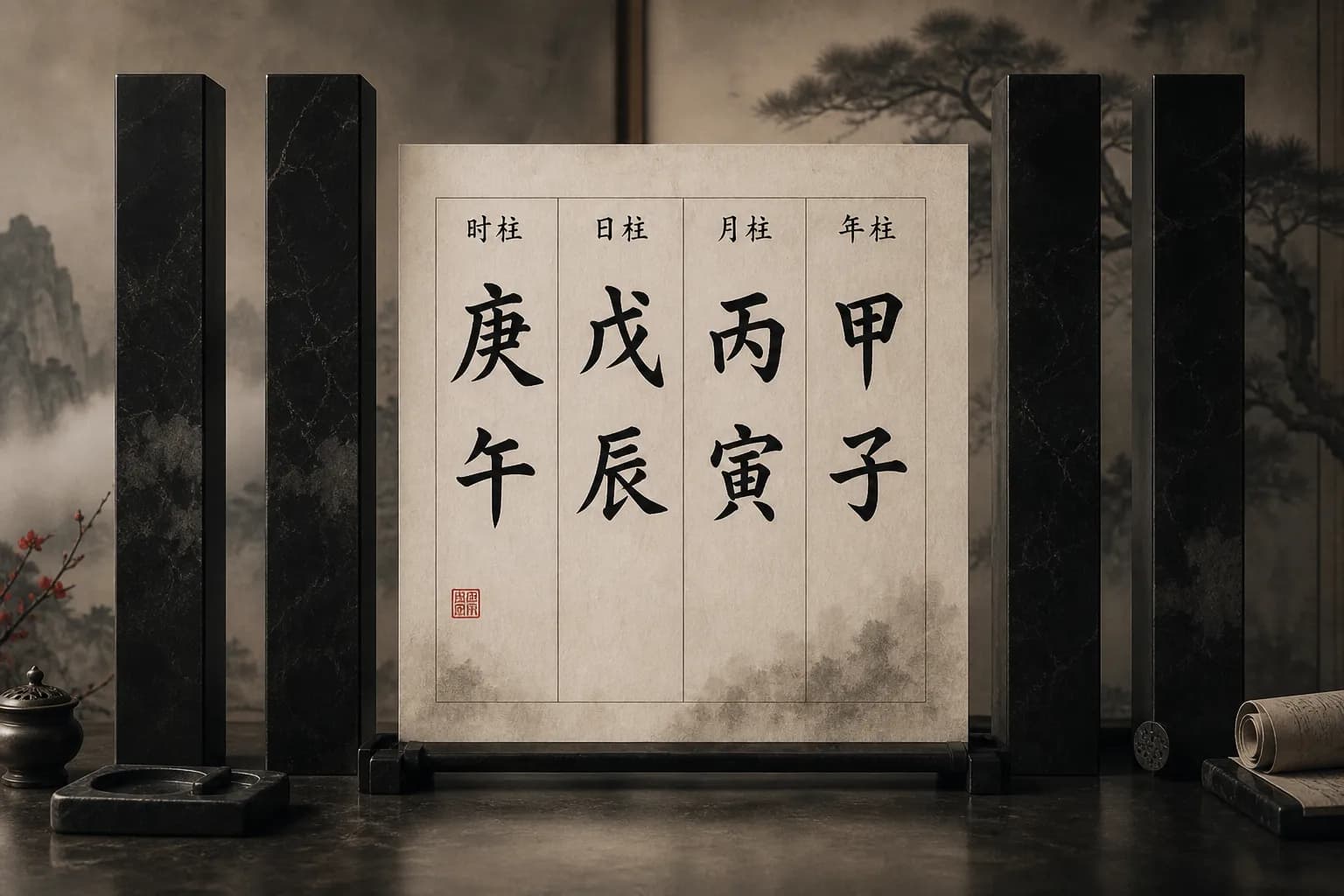
You have probably tried it already. Paste a birth date and time into ChatGPT, and within seconds it returns something that looks exactly like a Bazi reading: four pillars, a day master, a paragraph about your personality. It sounds confident. It even uses the right vocabulary. And yet the chart at the top of that answer — the four pillars everything else stands on — may simply be wrong.
Not because the model is unintelligent, but because casting a chart is not a language problem. It is calendar mathematics.
A Bazi chart is built from lookup tables and astronomical corrections, not from prose. The year pillar changes at Lichun (the beginning of spring, around February 4th) — not at New Year's Day and not at Lunar New Year, a distinction that quietly mislabels the zodiac animal for everyone born in early February. The month pillar switches at solar terms, which land on different dates each year. The day pillar rolls over at the Zi hour, around 23:00, so a birth at 23:40 belongs to the next day's pillar. And the hour pillar itself depends on local solar time: every degree of longitude shifts it by four minutes, which is why someone born at noon in Urumqi and someone born at noon in Shanghai — both stamped "12:00, Beijing time" on their birth certificates — lived through meaningfully different local hours.
A general-purpose model has none of these tables built in. It answers from patterns in text it has seen, which is usually close and occasionally exactly wrong — and Bazi lives at the boundaries. A two-hour solar-time correction does not matter for most people, but for someone born near midnight it can flip the day pillar, the day master, and with them the entire reading. The same goes for luck pillars: direction is set by the interaction of birth-year stem polarity and gender, and the starting age is a day-count to the next solar term, folded by the traditional rule. Each step is simple. Each step is a lookup. Miss one, and the fluent interpretation that follows is an eloquent commentary on the wrong chart.
Where general AI genuinely shines is everything after the chart is correct. Ask it what a Seven Killings day master means, why the same star reads differently in a strong or weak chart, or how Zheng Guan relates to career — the answers are usually thoughtful, and the ability to translate dry terminology into plain language is real. That is language work, and language is what it was built for.
So the honest division of labor is this: let a deterministic engine cast the chart — one whose calendar you can audit, whose solar-time correction you can switch on and verify — and let AI read the chart once the pillars are right. This is exactly how we built FateForge: the chart, the luck pillars, and the symbolic stars come out of a computation engine you can cross-check, and the AI does what AI is good at, which is telling you what the pattern means in your language.
If you want to test any tool — ours included — check the boundaries. Ask what rule it uses for births after 23:00. Ask when the year pillar changes for someone born in the first days of February. A tool that answers with a specific rule, and applies the same rule every time, deserves your trust on the arithmetic; a tool that answers with a mood, well — enjoy the conversation, but verify the chart.
Cast your chart free with the engine, then let the AI read it.