
Is Bazi Accurate? What the Four Pillars Can and Cannot Tell You
Bazi · July 18, 2026
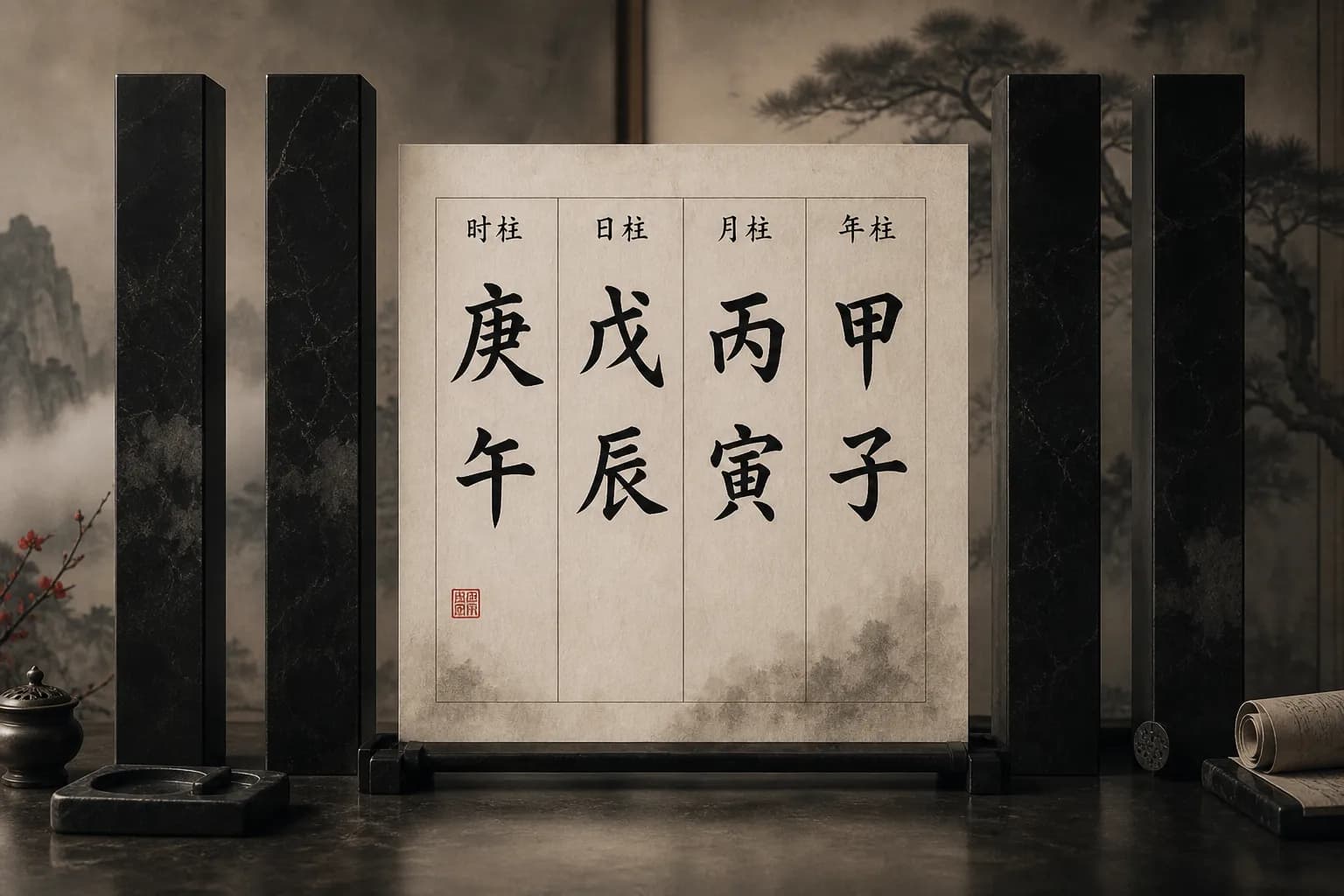
By this point in the series, you understand Bazi's basic structure: Heavenly Stems and Earthly Branches, Five Element interactions, the Ten Gods, pattern analysis, and the Major Luck cycles. The technical framework is in place. Now it's time to face the unavoidable question — **does this thing actually work?**
This isn't a question you can answer with a simple "yes" or "no." A more honest framing: Bazi performs reasonably well on certain dimensions, has structural blind spots on others, and the subjective experience of "accuracy" itself is distorted by cognitive biases. Let's take it apart.
First, Clarify the Question: What Kind of "Accurate"?
Before discussing whether Bazi is accurate, we need to define what we're even talking about. When people say "Bazi is spot on" or "Bazi is superstition," they're often not even discussing the same thing.
**Predicting specific events** — "You'll get divorced at 35" or "You'll strike it rich next year" — this is beyond what Bazi can do. Any interpretation that claims to achieve this is either overextending the framework or exploiting your fears and expectations. Bazi's structural precision is at the shichen (two-hour) level. At that resolution, you cannot infer specific events.
**Identifying tendencies and patterns** — "Under high-pressure situations, you tend to withdraw inward" or "Your wealth pattern is closer to creative generation than to accumulation and preservation" — this is something Bazi can potentially accomplish. And if it does, the value is considerable: understanding your own behavioral patterns is far more useful than knowing "which year you'll get rich."
**Providing cultural understanding** — Bazi is a traditional Chinese language for making sense of one's destiny. Learning it is inherently a conversation with a tradition that has been alive for two thousand years. This value exists on a completely different axis from "accuracy."
So this article focuses on the second layer: as a tool for identifying tendencies, where do the boundaries of Bazi's competence lie? The first layer (specific event prediction) and third layer (cultural value) we'll keep in parentheses — the former should never be promised, the latter stands independent of accuracy.
What Bazi Can Actually Do: An Elimination Argument
Rather than listing Bazi's "achievements," let's approach from the opposite direction — if a Bazi system captured absolutely nothing real, it couldn't have survived two thousand years.
**It captures structural power balances.** Eight characters, and the distribution of the Five Elements is not random. When a chart is dominated by Wood Element and Fire Element is nearly absent — this information is certain and reproducible. Two different practitioners examining the same chart won't disagree on the judgment "strong Wood, weak Fire." This is Bazi's algorithmic layer — casting the chart is pure mechanical lookup, and Five Element tallies are deterministic.
**It marks temporal milestones.** Major Luck cycles shift every ten years, Annual Luck changes every year. This provides a system for marking life phases. Of course, "marking" and "predicting" are different things. But marking itself has value — it forces you to ask: "How is my situation in this decade different from the last one?"
**It offers an interesting framework for personality classification.** The pattern system (Zhengguan pattern, Qisha pattern, Shishen pattern, Cong pattern...) is essentially a personality structure taxonomy. These categories are certainly not a replacement for personality psychology, but the fact that they derive from Five Element interactions with internal logical consistency means they're at least not "randomly invented labels." Shishen pattern and Qisha pattern describe fundamentally different energy modes, and you can see the distinction at a glance in a chart — the value of this rapid structural judgment is real.
**The weight of history cannot be ignored.** A pure scam couldn't have produced an academic tradition that continuously evolved — from the Tang dynasty's Li Xuzhong and his Three Pillars method, to the Ming dynasty's *San Ming Tong Hui* and *Zi Ping Zhen Quan* with their pattern systems, to modern scholars like Lu Zhiji's academic research. There have always been critical voices within the tradition: Zhang Shenfeng publicly challenged the validity of shensha (spirit stars), and Ren Tieshuo emphasized flexible application of the yongshen (useful element) rather than rigid formula-matching. A system with only deception and no real signal is unlikely to sustain this kind of internal critical vitality.
Structural Limitations: These Shortcomings Are System-Level, Not Method-Level
Having discussed what Bazi can do, let's turn to what it cannot — and let's be precise about the difference between "the method isn't good enough" and "the system is fundamentally incapable."
Temporal Precision: A Two-Hour Window
Bazi's finest granularity is the shichen — two hours per block. Globally, roughly four hundred thousand people are born every two hours. Those four hundred thousand people theoretically "share" the same Hour Pillar — their charts are identical at the Hour Pillar level.
What does this mean? If Bazi were truly precise to the individual, those four hundred thousand people should have highly similar lives. Clearly they don't. They might be born on different continents, into different families, in different eras. Bazi's temporal precision creates **irreversible information loss** — encoding a person's birth moment in eight Chinese characters discards most of the information.
This isn't "the method isn't precise enough." The only way to improve precision is to narrow the time window (for instance, true solar time correction down to the minute), but even then, people born in the same minute can have radically different fates. The fundamental problem is: **a birth moment cannot encode everything about a person.**
The Absence of Space and Environment
Traditional Bazi barely uses birthplace information (true solar time correction is an exception, but it only adjusts time — it doesn't introduce spatial semantics). Not using this information means ignoring the environment of upbringing — whether you were born in Beijing or Nairobi, family education, social systems, historical opportunities — these factors may influence a life by an order of magnitude more than the "natal chart."
Attributing a person's fate to their birth moment while ignoring what country, what era, and what family they were born into — this isn't merely incomplete information. It's almost a selective blindness to the largest variables in a person's fate.
From Chart Casting to Interpretation: Uncertainty Compounds
Chart casting is deterministic. But what comes after? Assessing the strength of the Day Master — there's room for disagreement here. Determining the pattern type — different schools can reach different conclusions. Selecting the yongshen — a single chart can support multiple reasonable yongshen choices. Calculating Major Luck — even the starting age has factional variations.
Every step introduces error, and errors propagate and amplify. In engineering terms, this is a **noise amplification system** — the initial input's uncertainty gets progressively amplified through multiple layers of processing. The "precision" of the final interpretation depends largely on the skill and integrity of the interpreter, not on the system's inherent accuracy.
Uneven Reliability: Some Components Are Stable, Others Are Just Lore
This point deserves expansion. Within Bazi's knowledge base, reliability is highly uneven.
Five Element interactions and the fundamentals of Heavenly Stems and Earthly Branches — these are at the algorithmic layer, with near-zero controversy. The core framework of pattern classification (the basic rules for determining Zhengguan pattern, Shishen pattern, Qisha pattern, etc.) — *Zi Ping Zhen Quan* established a relatively rigorous rule system; while factional disagreements exist, the basic framework is stable.
But when you reach the shensha system, the picture changes. Tianyi Guiren (Heavenly Nobleman), Wenchang (Literary Star) — these are determined by lookup tables, with reasonable consensus on usage. But Tongzi Sha (Child Spirit Calamity)? Yincuo Yangcha (Yin Error Yang Deviation)? Many shensha have definitional variations across versions, and their applications are disputed.
Zhang Shenfeng openly stated during the Ming dynasty that "principles of qi are primary; shensha are secondary" — meaning these marking systems shouldn't carry too much weight. If you see a practitioner making core judgments based heavily on low-reliability shensha — attributing a "lonely fate" to Tongzi Sha — the credibility of that interpretation should carry a big question mark. This isn't to say shensha are entirely useless — it's that their reliability level simply isn't on par with Five Element interactions or pattern analysis.
Cognitive Biases: Why You Feel "That's Really Accurate"
Even with the limitations described above, many people — including those who've studied Bazi — still have the experience that "sometimes it's genuinely quite accurate." This experience deserves to be taken seriously, because part of it may come from genuine pattern recognition, but part of it can be confidently attributed to cognitive biases.
The Barnum Effect
"You project a strong exterior, but deep inside you often feel insecure." This statement applies to nearly every human being. But when it appears in a Bazi interpretation, the reader tends to think "this is about me."
Bazi interpretations rely heavily on personality descriptions, and personality descriptions are naturally prone to triggering the Barnum Effect. This isn't to say Bazi descriptions are necessarily inaccurate — but when you feel they're "accurate," you have an obligation to first rule out this effect.
Confirmation Bias
A more potent bias. When you carry the premise "Bazi says I'm a Shishen pattern, and Shishen patterns indicate a gentle, creative nature" into examining your own behavior, you automatically notice moments when you're gentle and creative, while ignoring moments when you're irritable or uninspired. This isn't conscious — confirmation bias runs automatically.
The same applies to interpreters. If a practitioner forms the impression that "this chart has strong Wealth stars, suitable for business," they'll automatically attend to signals in the chart that support this judgment while ignoring contradictory ones.
Hindsight Bias
Looking back, "When my Major Luck entered the Seal Star year, my career did indeed change" — but you're aligning events after they've happened. If you gave the same chart to someone else without any event anchoring, they might construct an entirely different narrative. Hindsight bias makes Bazi interpretations look far more accurate in retrospect than they ever were prospectively.
Is There Any "Genuine Accuracy" After All?
Having confronted all the limitations and biases, an honest question remains: **if Bazi were pure noise, why do people continue to use it and benefit from it?**
I believe there's a reasonable middle ground.
**The framing effect is real.** Bazi provides a structured language for understanding yourself. Even if this framework isn't "truth," using it to examine your behavioral patterns, life phases, and interpersonal dynamics may reveal things you'd otherwise overlook. The label "Shishen pattern" itself isn't important — but the question it points to, "Do you tend to respond to pressure through creation and output, or through control and competition?" — is genuine and valuable.
**Cross-system convergence is worth noting.** Bazi and Ziwei Doushu use completely different reasoning engines. If their analyses of the same person point toward similar structural characteristics, this is unlikely to be pure coincidence. A similar convergence phenomenon exists between Western astrology and Vedic astrology. Of course, "multiple independent systems pointing in the same direction" doesn't equal "scientific confirmation" — but it at least reduces the probability of "pure noise."
**Pattern recognition may capture something real.** The Ten Gods system is essentially an encoding of interpersonal roles: Zhengyin (nourishment, education), Piancai (windfall wealth, adventure), Qisha (pressure, challenge). Do these role patterns have real-world counterparts in human interactions? I'd say it's very likely — but this hypothesis requires empirical research to test. It cannot be validated through case studies stacked up within the divination community itself.
Honest Advice for Practitioners
If you're interested in putting this series into practice, I have a few recommendations I stand by:
**Don't use Bazi for major decisions.** Bazi can be a thinking tool — a way to examine what you might be overlooking before making a decision. But it shouldn't replace your own judgment. If your Bazi reading says "this year is unfavorable for investment" but you've done thorough research and concluded you should invest — trust yourself.
**Be wary of over-precise assertions.** Any interpretation that claims to predict specific events (divorce dates, promotion timelines) should be treated with suspicion. Bazi's structural precision doesn't support this kind of assertion.
**Focus on patterns, ignore specific narratives.** "Your chart shows the Wealth star in the Year Pillar, indicating that early-life wealth comes from external sources rather than your own accumulation" — this describes a structural pattern and has value. "You will meet a major benefactor in 2028 who will change your life" — this is narrative. It sounds compelling, but it has no structural backing.
**Stay sensitive to the interpreter's school affiliation.** Pattern-focused schools and strength-weakness schools can reach different core judgments on the same chart. This isn't about who's right or wrong — it's about different analytical frameworks. A good interpreter will tell you which framework they're using and why they chose it.
**The ultimate measure is your own experience.** Whether Bazi is useful to you is something only you can judge. But when judging, remember to factor out the Barnum Effect and confirmation bias — if you still find it useful after accounting for these factors, that "usefulness" is most likely genuine.
In Closing: Bazi's Proper Place
Bazi is not science. The mainstream academic community does not treat it as a verifiable empirical system — because most of its core propositions haven't undergone rigorous statistical testing.
Nor is Bazi superstition. Those who call it superstition typically understand neither its technical structure nor its historical role (psychological comfort, social counseling, moral education, cultural transmission — far more complex than "fortune-telling").
I believe Bazi's most honest positioning is a **symbolic framework for self-reflection and cultural understanding**. It provides a language for understanding yourself and others, but this language is neither the only one nor an authoritative one. Its value lies in provoking thought, not in delivering answers.
The ultimate takeaway from studying Bazi shouldn't be "now I can read fortunes." It should be: you've gained a genuine understanding of how Chinese people have made sense of their own destinies for two thousand years, and you can find things within that tradition that illuminate your own life — while clearly knowing where those insights end.
This may be the most pragmatic attitude: **approach with curiosity and understanding, while maintaining clear-eyed critical awareness.**