Tarot vs I Ching: Two Oracles, Two Kinds of Answers
July 19, 2026 · Last verified: 2026-07-19
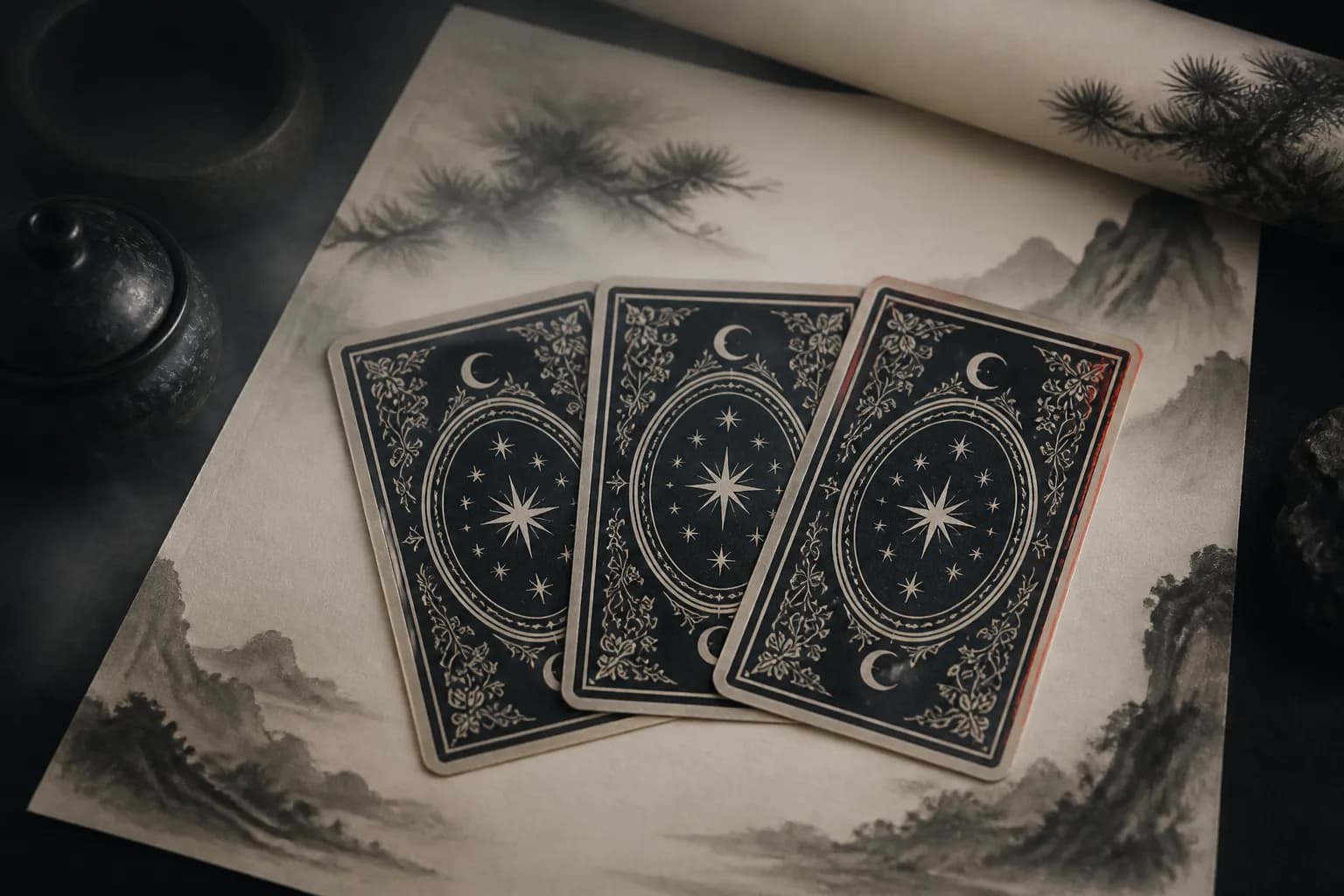
Tarot and the I Ching are the West's and China's most loved oracles — and they answer fundamentally different kinds of questions. Tarot works through images: 78 cards that mirror your emotional and archetypal state back at you. The I Ching works through process: 64 hexagrams built from yin and yang lines that describe how a situation is moving and what conduct the moment calls for. One tells you what you are feeling; the other tells you how things stand. This page compares the two honestly — including the same question cast in both systems — so you can choose the right oracle for the question you actually have.
The short answer
Tarot is a mirror of images — strong for emotional state, relationship texture, and archetypal patterns. The I Ching is a map of process — strong for how a situation is trending and what changing lines suggest about conduct and timing. Pick Tarot when you need to name what you feel; pick the I Ching when you need to read how things are moving and what the moment asks of you.
How each system answers a question
Tarot: shuffle (or draw online), lay a spread — often three cards for past/present/future or situation/action/outcome — and read the images. Seventy-eight cards (22 Major Arcana + 56 Minor Arcana) carry symbolic scenes. Input is mainly your question and attention; no birth data required. For how a three-card spread works, see /blog/tarot-three-card-spread.
I Ching: frame a question, cast hexagram lines (coins, yarrow, or digital), and receive a primary hexagram plus any changing lines that flip to a relating hexagram. Sixty-four hexagrams describe situations in motion. Input is the question and the moment of casting. For question framing, see /blog/liuyao-how-to-ask-question. FateForge's Liu Yao tool at /atlas/liuyao explains the hexagram, changing lines, and outcome in plain language.
The same question, asked both ways
Demonstration — fictional example for illustration only.
**Question:** "Should I accept the new role offer, or stay where I am?"
**Tarot (three-card spread):** Past — Eight of Cups: a pattern of leaving what no longer nourishes you emotionally. Present — Two of Wands: standing at a threshold, weighing vision against comfort. Outcome — The Chariot: forward motion if you commit direction — the cards mirror ambivalence and the need for a clear steer, not a bureaucratic yes/no.
**I Ching (hexagram with changing line):** Primary hexagram 46 (Pushing Upward) — steady advance through correct conduct; changing line in the third place suggests consolidating before pushing visibility. Relating hexagram 11 (Peace) — harmony when upper and lower cooperate. The reading emphasizes timing and posture: prepare the ground, then advance — less about naming feelings, more about how the situation rewards disciplined steps.
Same question, two answer shapes: Tarot reflects inner conflict and archetypal momentum; the I Ching describes situational flow and conduct. Neither is a command — both are material for reflection.
What each oracle is better at
| Question type | Better fit |
|---|---|
| Emotions, relationships, subconscious patterns | Tarot — /atlas/tarot |
| Strategy, timing, conduct in a situation | I Ching — /atlas/liuyao |
| Quick daily self-check | Tarot single card |
| Major decision with changing lines | I Ching |
| Yes-or-no with discipline | Plum Blossom daily cast — /atlas/meihua/daily-decision |
For card meanings, browse /tarot-cards. For hexagram texts, see /guides/64-hexagrams.
Tarot–I Ching correspondences
Modern writers have paired Major Arcana cards with hexagrams as an interpretive exercise. Examples (modern layer — not classical doctrine):
| Major Arcana | Hexagram | Note |
|---|---|---|
| The Fool (0) | 25 Innocence | Beginnings, trust in the unknown |
| The Magician (I) | 1 The Creative | Initiative, focused will |
| The High Priestess (II) | 2 The Receptive | Hidden knowledge, receptivity |
| Death (XIII) | 23 Splitting Apart | Ending that clears space |
| The Star (XVII) | 64 Before Completion | Hope amid unfinished process |
These pairings are a modern interpretive layer — Tarot developed in 15th-century Europe; the I Ching in Zhou-dynasty China roughly three thousand years ago. They did not historically correspond. Where we use such tables on FateForge, we label them as modern correspondence, not classical teaching.
Can you ask both the same question?
You can, but discipline matters. The respected pattern is to pick one primary system for the question and use the second only to check or deepen your interpretation of the first. Casting system after system until you hear what you want is not divination — it is answer-shopping. One honest reading, taken seriously, beats five convenient ones.
An oracle is a mirror, not a command. Whether you ask the cards or the hexagrams, the reading is material for your reflection — the choice and its consequences remain yours.
FAQ
Is Tarot or the I Ching better for yes-or-no questions?
The I Ching is traditionally the more direct fit: a cast hexagram with its changing lines speaks to a situation's direction and the conduct it calls for. Tarot can answer yes-or-no questions, but its images usually give you more context than a clean binary. Whichever you use, frame the question as "what do I need to understand about…" rather than "will X happen" — you will get an answer you can actually act on.
Which is easier to learn?
Tarot has the gentler entry: the 78 card images carry immediate intuitive meaning, and a three-card spread is learnable in an afternoon. The I Ching asks more of you up front — 64 hexagrams, changing lines, and classical texts — but rewards that effort with unusually structured guidance. Many people start with Tarot for self-reflection and add the I Ching when their questions become more strategic.
Can I ask both systems the same question?
You can, but discipline matters. The respected pattern is to pick one primary system for the question and use the second only to check or deepen your interpretation of the first. Casting system after system until you hear what you want is not divination — it is answer-shopping. One honest reading, taken seriously, beats five convenient ones.
Are Tarot cards and I Ching hexagrams connected?
Not historically. They developed independently — Tarot in 15th-century Europe, the I Ching in Zhou-dynasty China roughly three thousand years ago. Modern writers have proposed correspondence tables pairing Major Arcana with hexagrams; these are interesting as an interpretive exercise, but they are a modern layer, not classical doctrine, and we label them as such wherever they appear on this site.
Where can I try both online for free?
FateForge offers both: a free Tarot reading with AI interpretation, and a free I Ching casting that explains the hexagram, its changing lines, and the outcome in plain language. No signup is required for either.
Try both free
Draw Tarot at /atlas/tarot — free reading with AI interpretation. Cast the I Ching at /atlas/liuyao — hexagram, changing lines, and plain-language outcome. For a quick yes-or-no daily cast, try /atlas/meihua/daily-decision. No signup required.