
Gui (Yin Water 癸)
Permeating, quiet, finely nourishing — the rain-dew pattern
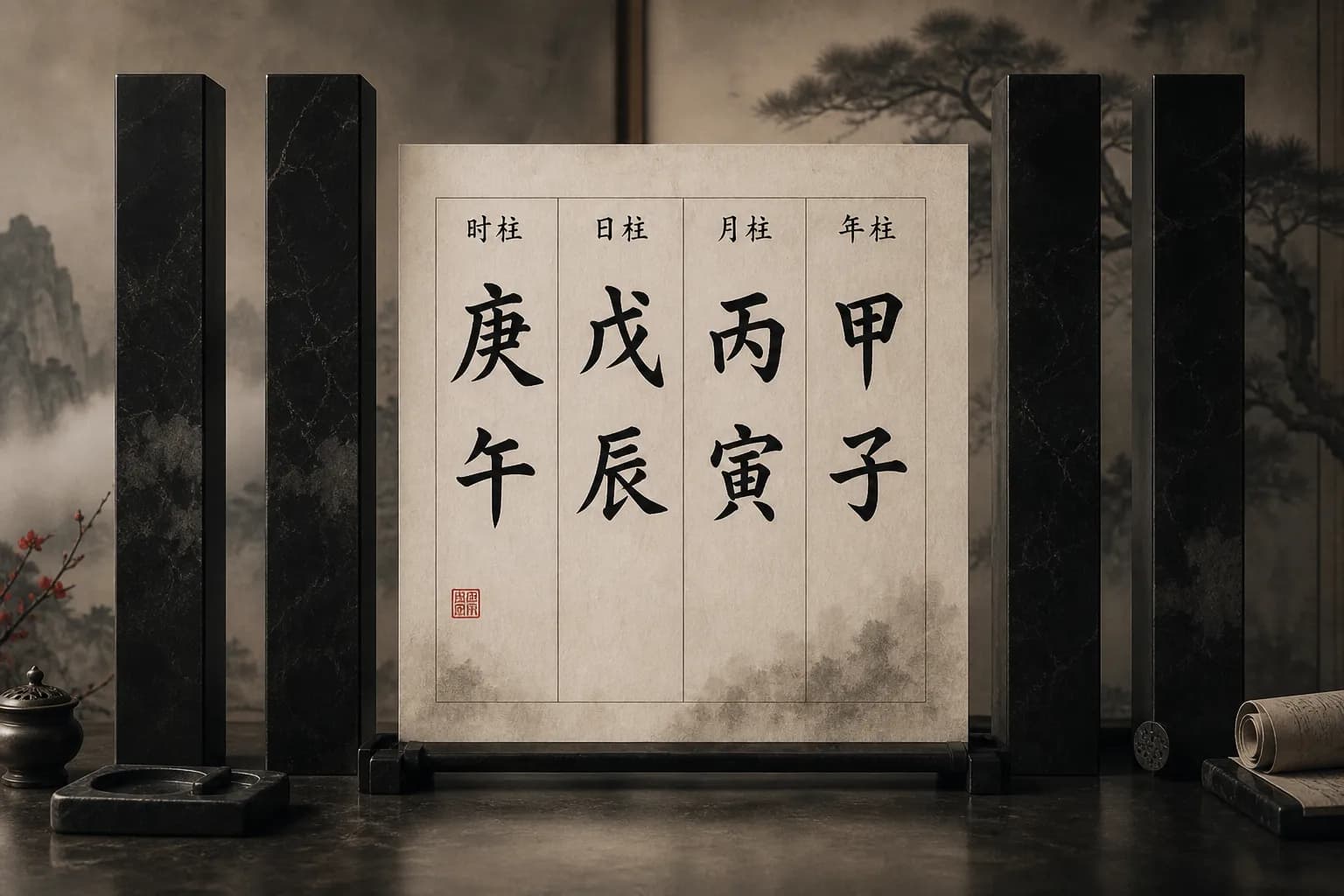
The day pillar shows 癸 — a Gui day master, Yin Water in BaZi's ten-stem set. If you searched "gui day master" or "yin water day master," you likely want pattern language, not a verdict on fate. Within this system, Gui is the self-reference stem on your day pillar, traditionally imaged as rain, dew, mist, or underground springs: water that arrives quietly and soaks in over time. That may suggest subtle influence and attentive care, but only with the full chart in view. Verify yours on a free Four Pillars chart, then read how tradition tends to frame the rain-dew image.
What is the Gui (Yin Water 癸) day master?
Your Day Master is the Heavenly Stem on the day pillar — the reference for Ten Gods and strength. Gui (癸) is Yin Water, classically imaged as dew, rain, or fine streams: moisture that permeates rather than announces itself. Tradition uses Gui to discuss intuition, quiet persistence, and influence through presence rather than volume — always as pattern, never as fixed identity. See Heavenly Stems for stem placement and Ten Gods for roles generated from the Day Master.
癸水至弱,达于天津。
— 滴天髓
How to find your Day Master
Within this system, finding your Day Master takes three steps: (1) generate your Four Pillars chart from birth date and time; (2) locate the day pillar — the third column, marked Day; (3) read its Heavenly Stem (top character). That stem is your Day Master. Unlike the year branch (shared by everyone born that year), the day stem is one of the chart's most individual anchors — though month and hour can still coincide with others. For Ten Gods and full structure, use the Four Pillars tool.
The rain and dew: the core pattern
The rain-dew image points to a pattern of quiet permeation within this system. Tradition may suggest Gui Day Masters tend to notice small shifts, nurture through consistency, and affect environments without occupying center stage. When the chart lacks support or faces strong Fire and wind, the same moisture can read as evaporating quickly — overlooked, easily dried out, or anxious about visibility. The archetype is a handle for reflection, not a requirement to stay invisible.
Strengths and friction points
Supported Yin Water often reads as empathy, perceptiveness, and ability to soften hard edges in a group. Friction appears when quiet giving is taken for granted: resentment at being unseen, difficulty claiming credit, or absorbing others' moods until personal boundaries blur. Gui charts sometimes show gentle wisdom alongside fragility under harsh scrutiny — dew that nourishes at dawn but vanishes under midday sun. These paired tendencies depend on chart climate, not moral score.
Gui (Yin Water 癸) in career and work
In work settings, Gui patterns may suggest environments where research, editing, care work, or behind-the-scenes coordination matters — roles that reward precision and sustained attention over loud self-promotion. Tradition may indicate strain in cultures that only reward visible aggression, or roles where subtle contribution is constantly erased. A Gui Day Master with Metal support might read as sharp and analytical; with overwhelming Fire, the same stem might feel exposed or quickly depleted. Describe fit as pattern, not prescription.
Gui (Yin Water 癸) in relationships
Gui traditionally combines with Wu Yang Earth (戊癸合) — rain-dew and mountain, often described as quiet moisture meeting stable ground. Explore serious compatibility through relationship chart analysis, not stem labels alone. Compared with Ren Yang Water (great river), Gui may read as more intimate and finely tuned in relational style — see the Ren guide for the Yang Water contrast.
When the rest of the chart changes the picture
Two Gui Day Masters can diverge sharply: one with Water season support and gentle Metal may present as intuitive, articulate, and quietly persuasive; one with strong Fire and dry Earth may experience the same stem as anxious, invisible, or emotionally parched. Strong versus weak Day Master, birth season, and luck pillars rewrite every section above — which is why Five Elements balance and the Day Master × Wu Xing method guide matter more than any single-stem essay. The Day Master is one of eight characters: a reference coordinate, not the whole map.
The day master is a reference point, not a verdict — the reading is yours to use.
FAQ
Is Gui a good day master?
Within this system there is no ranking of better or worse Day Masters — only structure and context. Gui describes a Yin Water pattern; whether that pattern feels supportive depends on season, strength, Ten Gods, and luck cycles, not the stem label alone.
How do I know if I'm a Gui day master?
Check the Heavenly Stem on your day pillar after you generate your Four Pillars chart. If the day stem is 癸, you are a Gui Day Master.
How is Gui (Yin Water) different from Ren (Yang Water)?
Ren is the great river — broad and strategic; Gui is rain and dew — quiet and permeating. See the Ren Water guide for the Yang Water contrast; the full chart decides which water story dominates.
What element is Gui?
Gui is Yin Water. See the Four Pillars chart; for stem placement in all pillars, see Heavenly Stems.