
Wu (Yang Earth 戊)
Stable, bearing, trustworthy — the mountain pattern
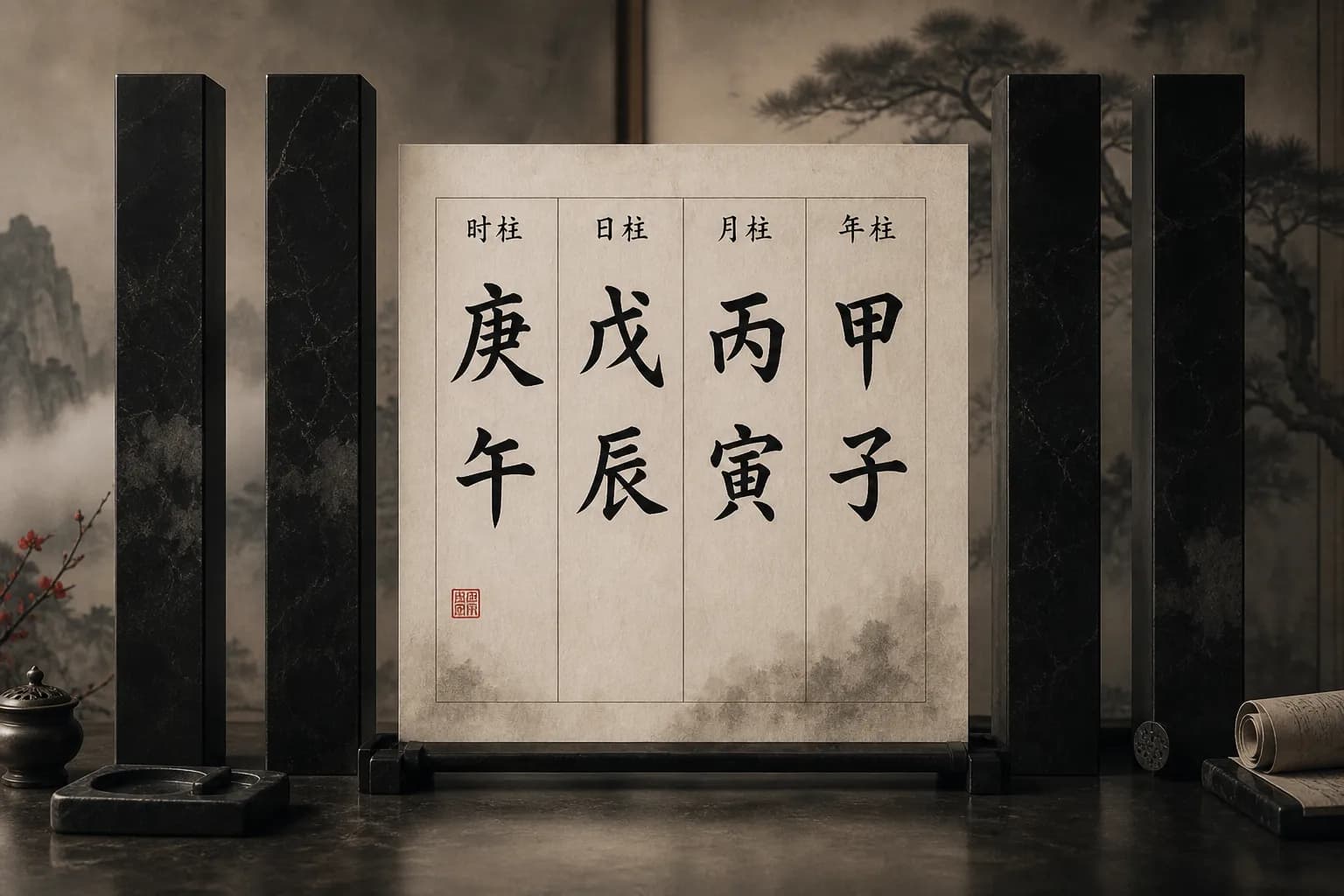
Your day pillar shows 戊 — a Wu day master, Yang Earth among the ten Heavenly Stems. Searches for "wu day master" or "yang earth day master" often return slow, stubborn trait lists; within this system, Wu is your chart's self-reference coordinate, traditionally imaged as a high mountain or thick earth. That may suggest themes of stability, reliability, and carrying weight for others, but only when season, strength, and the other seven characters are read together. Confirm the stem on a free Four Pillars chart, then explore how tradition tends to frame the mountain image as pattern language.
What is the Wu (Yang Earth 戊) day master?
The Day Master is the Heavenly Stem on your day pillar — the anchor from which Ten Gods and strength readings are taken. Wu (戊) is Yang Earth, classically imaged as mountains, city walls, or broad plateau: mass that holds position and absorbs pressure. Classical texts use Wu to discuss steadiness, credibility, and patience under load — as tendency, not as a guarantee of virtue. For stem mechanics in all four pillars see Heavenly Stems; for roles generated from the Day Master see Ten Gods.
戊土固重,既中且正。
— 滴天髓
How to find your Day Master
Within this system, finding your Day Master takes three steps: (1) generate your Four Pillars chart from birth date and time; (2) locate the day pillar — the third column, marked Day; (3) read its Heavenly Stem (top character). That stem is your Day Master. Unlike the year branch (shared by everyone born that year), the day stem is one of the chart's most individual anchors — though month and hour can still coincide with others. For Ten Gods and full structure, use the Four Pillars tool.
The mountain: the core pattern
The mountain image maps to a core pattern within this system: presence that prefers firm ground, visible reliability, and slow but durable movement. Tradition may suggest Wu Day Masters tend to act as anchors — people others lean on when plans need weight rather than speed. When the chart lacks Wood to loosen or Water to channel, the same mass can read as inertia, stubbornness, or difficulty changing course once a path is chosen. The image is a handle for reflection, not a sentence on temperament.
Strengths and friction points
When Yang Earth qi is supported, readings may highlight trustworthiness, endurance, and ability to protect a group by holding the line. Friction appears when mass becomes immovable: delayed decisions, resistance to new information, or carrying everyone else's problems because saying no feels like collapsing the structure. Wu charts sometimes show principled steadiness alongside rigidity — the same reliability that steadies a team can feel like obstruction when flexibility is needed. These paired tendencies depend on season and the other seven characters, not moral ranking.
Wu (Yang Earth 戊) in career and work
In work settings, Wu patterns may suggest environments where consistency, governance, or long-cycle projects matter — spaces that reward showing up and finishing rather than constant reinvention. Tradition may indicate strain in hyper-fluid cultures with no stable reference points, or roles that demand instant pivots without time to test foundations. A Wu Day Master with strong Wood might read as constructive and open to reform; the same stem with clashing Wood might feel blocked or overly defensive. Describe fit as pattern, not prescription.
Wu (Yang Earth 戊) in relationships
Wu traditionally combines with Gui Yin Water (戊癸合) — mountain and rain-dew, often described as stable earth meeting quiet nourishment. That is symbolic pairing language, not a compatibility verdict; serious questions belong in relationship chart analysis. Compared with Ji Yin Earth (garden soil), Wu may read as more monumental and less adaptive in how care is expressed — see the Ji guide for the Yin Earth contrast.
When the rest of the chart changes the picture
Two Wu Day Masters can diverge sharply: one born in late summer with Earth season support may present as calm, authoritative, and generous with stability; one born in spring with heavy Wood clash may experience the same stem as pressured, slow, or tired from holding too much. Strong versus weak Day Master, birth season, and luck pillars rewrite every section above — which is why Five Elements balance and the Day Master × Wu Xing method guide matter more than any single-stem essay. The Day Master is one of eight characters: a reference coordinate, not the whole map.
The day master is a reference point, not a verdict — the reading is yours to use.
FAQ
Is Wu a good day master?
Within this system there is no ranking of better or worse Day Masters — only structure and context. Wu describes a Yang Earth pattern; whether that pattern feels supportive depends on season, strength, Ten Gods, and luck cycles, not the stem label alone.
How do I know if I'm a Wu day master?
Check the Heavenly Stem on your day pillar after you generate your Four Pillars chart. If the day stem is 戊, you are a Wu Day Master.
How is Wu (Yang Earth) different from Ji (Yin Earth)?
Wu is the mountain — broad, bearing, slow to move; Ji is garden soil — cultivating, nurturing, adaptive. See the Ji Earth guide for the Yin Earth contrast; your chart decides which earth story dominates.
What element is Wu?
Wu is Yang Earth. See the Four Pillars chart; for stem placement in all pillars, see Heavenly Stems.